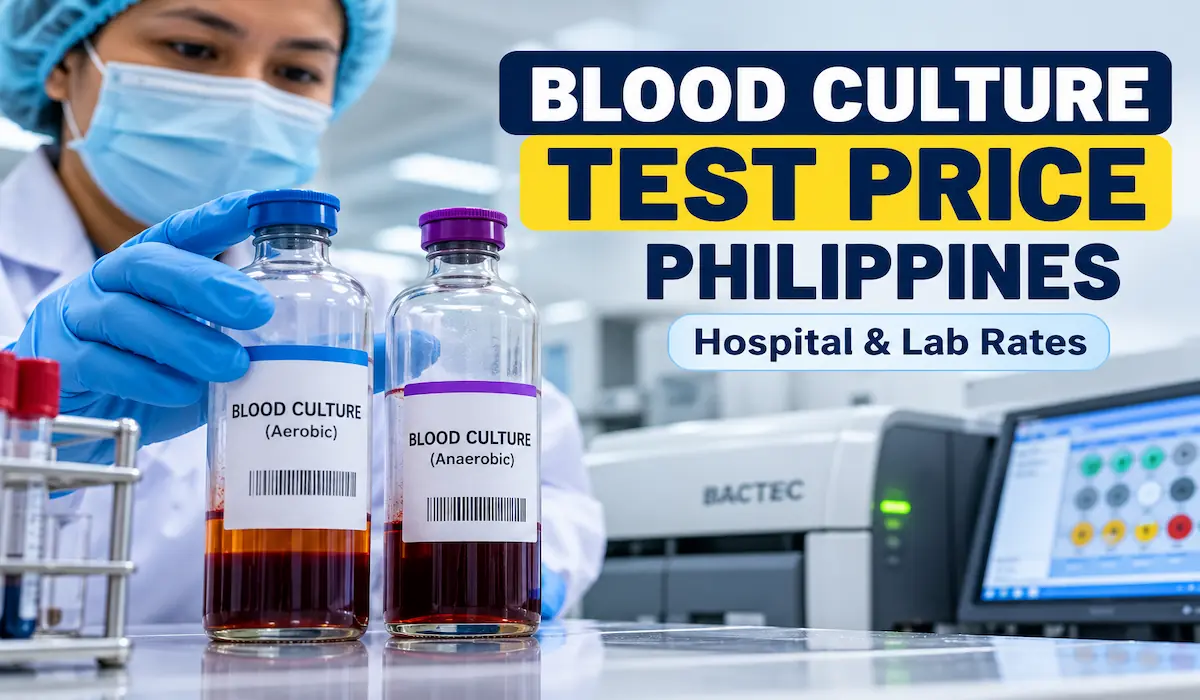
Blood Culture Test Price Philippines 2026: Hospital & Lab Rates
Quick answer: Standard blood culture and sensitivity (C&S) tests cost about ₱1,505 to ₱5,150 at selected Philippine hospitals. Rates include ₱1,633 without ARD and ₱1,764 with ARD at Amang Rodriguez Memorial Medical Center, ₱1,800 for PGH outpatient-pay patients, and ₱3,800 at Holy Name University Medical Center. If two blood culture sets are ordered and billed separately, the total can be substantially higher. Some government hospitals offer reduced or free services to qualifying patients. These are observed published rates, not a national average.
When it is used: A blood culture test checks whether bacteria or fungi are present in the bloodstream. Doctors may order it when they suspect a serious infection, sepsis, infective endocarditis, or an unexplained fever that requires further investigation. If microorganisms grow, the laboratory may identify them and perform sensitivity testing to help guide treatment. When feasible, blood cultures are ideally collected before antibiotics without delaying urgent treatment.
Blood Culture Test Prices
| Types | Published price |
|---|---|
| Standard blood culture and sensitivity | ₱1,505–₱5,150 |
| Blood culture without ARD | ₱1,633 |
| Blood culture with ARD | ₱1,764 |
| PGH outpatient blood C&S | ₱1,800 |
| Two sets at ₱1,800 per set | ₱3,600 |
| Blood culture with Gram stain | ₱3,306 |
| Fungal blood culture | ₱3,860 |
| Subsidized blood culture | Reduced or free |
Important: The quoted price may refer to a culture service, one bottle, one complete set, or a bundled order. Always confirm the billing unit before estimating the cost of two collection sites.
Blood Culture Prices by Hospital in the Philippines
| Hospital | Location | Published price |
|---|---|---|
| Dr. Jose Fabella Memorial Hospital | Manila | ₱1,505 standard rate |
| Amang Rodriguez Memorial Medical Center | Marikina | ₱1,633 without ARD; ₱1,764 with ARD |
| J.R. Borja General Hospital | Cagayan de Oro | ₱1,650 full-rate category |
| UP-Philippine General Hospital | Manila | ₱1,800 outpatient-pay |
| Baguio General Hospital and Medical Center | Baguio | ₱1,920 older published rate |
| Zamboanga City Medical Center | Zamboanga City | ₱2,370 |
| Amai Pakpak Medical Center | Marawi City | ₱2,500 |
| Dr. Jose Rizal Memorial Hospital | Dapitan City | ₱2,900 listed per-site rate |
| Eastern Visayas Medical Center | Tacloban City | ₱2,900 |
| The Medical City South Luzon | Laguna | ₱3,327.50 published example |
| Lung Center of the Philippines | Quezon City | ₱3,400, plus a listed ₱272 reader’s fee in an older schedule |
| Holy Name University Medical Center | Tagbilaran City | ₱3,800 |
| Ilocos Sur Medical Center | Candon City | ₱5,150 |
These amounts come from hospital price lists published in different years and under different billing classifications. Older rates are historical references and should not be treated as guaranteed current quotations.
UP-PGH blood culture price
The University of the Philippines–Philippine General Hospital publishes different blood culture and sensitivity rates depending on the patient’s billing category.
| PGH category | Published price |
|---|---|
| Service rate | ₱825 |
| Outpatient-pay | ₱1,800 |
| Ward / semi-private | ₱2,430 |
| Private | ₱2,550 |
| Suite / deluxe | ₱2,680 |
The ₱825 service rate is not automatically the cash price for an ordinary paying outpatient.
For outpatient-pay patients, PGH lists ₱1,800. The applicable charge can differ for admitted patients according to accommodation and billing classification.
Amang Rodriguez Memorial Medical Center blood culture price
Amang Rodriguez Memorial Medical Center in Marikina lists two blood culture options in its 2026 Citizens’ Charter:
| Laboratory service | Price |
|---|---|
| Blood culture without ARD | ₱1,633 |
| Blood culture with ARD | ₱1,764 |
The difference is ₱131.
ARD refers to an antibiotic-removal device. These culture systems are designed to reduce the effect of certain antimicrobial medicines on organism recovery.
The laboratory determines which bottles and collection method are appropriate. Patients should not select an ARD bottle simply because it costs more.
J.R. Borja General Hospital blood culture price
J.R. Borja General Hospital in Cagayan de Oro publishes several patient-rate categories for its BACTEC blood culture service.
The previously reviewed schedule lists:
- ₱1,650 — full rate.
- ₱1,238 — reduced category.
- ₱825 — further reduced category.
- Free — eligible category.
The applicable amount depends on the hospital’s patient classification and assistance rules. A free or subsidized category should not be interpreted as a universal free blood culture service.
Eastern Visayas Medical Center blood culture price
Eastern Visayas Medical Center’s March 2026 Citizens’ Charter lists:
| Service | Published price |
|---|---|
| Blood culture and sensitivity | ₱2,900 |
| Blood culture and sensitivity with Gram stain | ₱3,306 |
The difference is ₱406. Ask whether the quoted price includes Gram staining, organism identification, and antibiotic susceptibility testing.
Private hospital blood culture prices
Private hospital rates also differ by test type and billing arrangement. Examples from the reviewed price lists include:
| Private hospital | Published price |
|---|---|
| Davao Doctors Hospital | ₱1,811–₱2,279, depending on listed bottle type and billing outlet |
| The Medical City South Luzon | ₱3,327.50 |
| Holy Name University Medical Center | ₱3,800 |
| Cagayan de Oro Medical Center | ₱3,300 for a historical two-site listing |
The Davao Doctors rates distinguish different bottle options, including antibiotic-removal configurations. The Cagayan de Oro Medical Center amount is from an older catalog and requires confirmation.
These examples demonstrate why a single quoted price is not enough to determine the cost of a complete two-set order.
Why Doctors May Order Blood Cultures from Two Sites
A blood culture set commonly consists of an aerobic and an anaerobic bottle collected during one blood draw. Doctors may order two or more sets from separate venipuncture sites.
Collecting multiple sets can improve the chance of detecting a bloodstream infection and help distinguish a true infection from contamination introduced during collection.
How much do two blood culture sets cost?
If the laboratory charges separately for each complete set, the estimated cost is:
| Price per complete set | Two-set calculation |
|---|---|
| ₱1,633 | ₱3,266 |
| ₱1,800 | ₱3,600 |
| ₱2,370 | ₱4,740 |
| ₱2,900 | ₱5,800 |
| ₱3,400 | ₱6,800 |
| ₱3,800 | ₱7,600 |
| ₱5,150 | ₱10,300 |
These are mathematical examples, not confirmed hospital two-set package prices. They apply only when the hospital’s quoted amount is for one complete set and the facility bills each set separately.
Some laboratories price each bottle separately, while others quote a bundled order or a two-site package. For the most accurate estimate, ask: “Does this quotation cover one bottle, one blood culture set, or both sites ordered by my doctor?”
Blood Culture With ARD vs Without ARD
Some hospital laboratory lists distinguish blood culture bottles with and without an antibiotic-removal device. ARD or resin-containing systems are intended to reduce the effect of certain antibiotics already present in a patient’s blood sample.
| Feature | Without ARD | With ARD |
|---|---|---|
| Main purpose | Routine microbial detection | Microbial detection with antibiotic-neutralizing technology |
| Example ARMMC price | ₱1,633 | ₱1,764 |
| Difference | — | ₱131 more |
| Who determines use | Healthcare team and laboratory | Healthcare team and laboratory |
An ARD bottle does not guarantee a positive result or eliminate the effects of every antibiotic. Patients who have already started treatment should inform their healthcare team rather than stopping medicines independently.
Blood Culture vs Blood Culture and Sensitivity
A blood culture and a blood culture and sensitivity test are closely related, but their billing inclusions may differ. Blood culture involves incubating blood samples to detect microbial growth.
Blood culture and sensitivity (C&S) includes susceptibility testing when an appropriate microorganism is recovered and the laboratory performs that testing. A hospital may use service descriptions such as:
- Blood culture.
- Blood C&S.
- Blood culture with automated identification.
- Blood culture with MIC.
- Blood culture with Gram stain and sensitivity.
MIC means minimum inhibitory concentration, a laboratory measurement used to help evaluate antimicrobial susceptibility. Some laboratories bundle identification and susceptibility testing into one price. Others bill certain procedures separately.
Bacterial vs Fungal Blood Culture Prices
Most routine blood cultures investigate bacterial bloodstream infections, although some routine systems can also detect certain yeasts. A fungal blood culture may involve different methods or extended laboratory processing.
Zamboanga City Medical Center lists ₱3,860 for fungal culture and sensitivity of blood. The appropriate test depends on the suspected infection and the doctor’s request. A routine bacterial culture should not automatically replace a specifically ordered fungal investigation.
What May Increase Your Final Blood Culture Bill?
| Possible extra expense | When it may apply |
|---|---|
| Additional culture bottles or sets | When multiple collections are separately billed |
| Antibiotic-removal bottles | When a higher-priced bottle system is used |
| Gram stain | If not included in the culture package |
| Organism identification | If separately billed after a positive culture |
| Antibiotic susceptibility testing | If excluded from the base price |
| Reader’s or professional fee | At hospitals with separate listed fees |
| Blood collection supplies | If billed separately |
| Emergency room charges | If collected during emergency assessment |
| Additional laboratory tests | CBC, procalcitonin, CRP, or other tests when ordered |
| Hospital admission | If inpatient treatment is necessary |
For example, an older Lung Center schedule lists a ₱272 reader’s fee in addition to its ₱3,400 blood culture price. That produces a listed total of ₱3,672, before any other applicable charges. Do not assume that every hospital adds a separate reader’s fee.
Government Hospital Discounts and Financial Assistance
Government hospitals may offer reduced charges to patients who qualify under their financial or social-service classifications. This is different from the regular outpatient-pay rate.
Some public hospitals publish several price categories, while others determine financial assistance after an assessment.
Can a blood culture be free?
It can be free for qualifying patients at facilities with subsidized or charity billing categories. For example, J.R. Borja General Hospital’s reviewed schedule includes a free patient category. However, blood culture is not automatically free at every public hospital.
Ask the hospital’s social service or medical social work department about eligibility and required documents.
Can Malasakit Centers help?
Malasakit Centers at participating government hospitals help eligible patients access medical financial assistance through relevant government agencies and programs. Assistance may help with eligible hospital bills, including medically necessary services, subject to assessment and program rules.
It is not a guaranteed reimbursement for a blood culture purchased independently at a private laboratory. For admitted patients who cannot cover their remaining bill, ask the hospital’s social service office whether Malasakit assistance is available.
Does PhilHealth Cover Blood Culture Tests?
PhilHealth may help cover medically necessary laboratory services provided during an eligible hospital admission.
However, the benefit is generally processed through the applicable hospital case-rate or other payment arrangement, not as a universal fixed discount on each blood culture.
During hospital admission
A blood culture ordered during confinement may appear among the patient’s laboratory charges. PhilHealth benefits are applied according to the covered diagnosis, accredited facility, eligibility, and applicable billing rules.
The final patient balance may still depend on other hospital charges and benefit limitations.
Is blood culture covered under PhilHealth YAKAP?
PhilHealth YAKAP provides primary-care consultations and a defined range of laboratory and diagnostic benefits. Blood culture is not confirmed as a standard standalone YAKAP-covered laboratory service in the published benefits reviewed.
Patients should not assume that registration with a YAKAP clinic makes a private blood culture free. For official information, visit:
HMO Coverage for Blood Culture
An HMO may cover medically necessary blood culture testing when it falls within the member’s inpatient or outpatient diagnostic benefits. Coverage depends on the policy, accredited facility, authorization requirements, and benefit limits.
Before booking an outpatient culture, check whether:
- The hospital or laboratory is accredited.
- A doctor’s request is required.
- A letter of authorization (LOA) is needed.
- The plan covers culture and sensitivity testing.
- The number of bottles or sets affects the approved amount.
For emergency and inpatient care, authorization procedures may differ.
Senior Citizen and PWD Discounts
Eligible senior citizens and persons with disabilities may qualify for the applicable 20% statutory discount and VAT exemption on covered medical and laboratory services under Philippine law.
The calculation depends on the type of facility, eligible charges, applicable rules, and documentation. Senior citizens and PWDs should present the appropriate identification and ask the billing office to apply the correct benefits.
A reduced government hospital rate, package arrangement, or promotional price may require a different billing calculation.
How Is a Blood Culture Test Done?
Blood cultures are collected by trained healthcare personnel using sterile techniques. The procedure usually involves:
- Confirming the patient’s identity and doctor’s request.
- Cleaning the collection site with an appropriate antiseptic.
- Drawing blood from a vein.
- Filling the designated blood culture bottles with the required volume.
- Collecting additional sets from separate sites when ordered.
- Sending the specimens promptly to the microbiology laboratory.
The laboratory incubates the bottles and monitors them for microbial growth. If organisms grow, additional identification and susceptibility testing may follow.
Is blood culture painful?
Blood collection can cause brief needle discomfort and occasionally minor bruising. When multiple sets are required, separate needle insertions may be needed.
Do You Need to Fast Before Blood Culture?
Fasting is generally not required. Patients usually do not need to avoid food or water specifically for a routine blood culture. However, the doctor may order other examinations that have separate preparation requirements.
Follow the instructions provided by the treating team.
Should blood culture be collected before antibiotics?
Blood cultures are ideally collected before starting antimicrobial treatment when medically feasible. Antibiotics can reduce the chance of recovering bacteria from the specimen. However, urgent treatment for suspected sepsis should not be delayed simply to complete blood culture collection.
If antibiotics have already been started, tell the healthcare team. Do not stop prescribed medicines without medical advice.
How Long Do Blood Culture Results Take?
| Result stage | General timeframe |
|---|---|
| Blood collection | Usually several minutes per collection |
| Early positive signal | Sometimes within 24–48 hours |
| Organism identification | Additional processing after growth is detected |
| Antibiotic sensitivity | Additional time after organism recovery |
| Final negative routine bacterial culture | Commonly around 5 days |
| Specialized fungal cultures | May take longer |
Actual turnaround depends on the laboratory, organism, equipment, and testing method. A preliminary positive result may be reported urgently to the treating doctor before the final report is ready.
What does a positive blood culture mean?
A positive culture means microorganisms grew in the laboratory specimen. This can indicate a bloodstream infection, although some positive results arise from contamination during specimen collection.
Doctors consider the organism identified, number of positive culture sets, clinical symptoms, and other findings.
Does a negative blood culture rule out infection?
No. A negative blood culture does not exclude every bloodstream infection. Previous antibiotic treatment, specimen volume, intermittent bloodstream infection, and other factors may affect the result.
Blood Culture vs CBC: What’s the Difference?
| Feature | Blood culture | CBC |
|---|---|---|
| Main purpose | Detect microorganisms in the bloodstream | Measure blood cells |
| Detects bacteria directly? | Can grow and identify bacteria | No |
| Antibiotic sensitivity testing? | May be performed after positive growth | No |
| Typical reporting time | Several days for final results | Often much faster |
| Common use | Suspected bloodstream infection | Broad assessment of blood-cell abnormalities |
Doctors may order both tests because they answer different questions. A CBC cannot replace a blood culture when identifying a bloodstream pathogen is necessary.
Frequently Asked Questions
Magkano ang blood culture test sa Pilipinas?
Published standard hospital rates reviewed by CareCostPH range from approximately ₱1,505 to ₱5,150. The total can increase if multiple sets are billed separately.
Magkano ang blood culture sa PGH?
PGH lists ₱1,800 for outpatient-pay patients. It also publishes a ₱825 service rate and higher inpatient rates depending on the billing category.
Why do some hospitals charge ₱825 or less?
Some hospital price schedules contain service, subsidized, or reduced-rate categories. These are not automatically available to all patients.
How much is a two-site blood culture?
It depends on the facility’s billing method. If each complete set costs ₱1,800 and two are billed separately, the calculated total is ₱3,600. Confirm whether the quotation is per bottle, per set, or bundled.
Is a blood culture available in government hospitals?
Yes. Government hospitals including PGH, Amang Rodriguez Memorial Medical Center, Eastern Visayas Medical Center, and others publish blood culture services.
Can I get a blood culture without a doctor’s request?
Blood culture is normally requested following a clinical assessment, especially when a serious infection is suspected. Laboratory policies differ, so confirm the requirements with the facility.
Ilang araw ang result ng blood culture?
Routine bacterial cultures commonly require several days. A final negative result may take around five days, while positive results may be communicated earlier.
Is blood culture the same as blood typing?
No. Blood typing identifies the ABO and Rh blood group. Blood culture investigates microorganisms in the bloodstream.
Can blood culture detect sepsis?
A blood culture may identify microorganisms causing a bloodstream infection associated with sepsis. However, sepsis is diagnosed using the patient’s clinical condition and other findings, not a blood culture alone.
Before You Pay for a Blood Culture Test
Ask the hospital these questions before accepting the quotation:
- Is the price per bottle, per set, or for the entire order?
- How many sets or collection sites are required?
- Are aerobic and anaerobic bottles included?
- Will the laboratory use bottles with ARD?
- Are Gram stain, organism identification, and sensitivity testing included?
- Are collection, reader’s, or professional fees charged separately?
- When will preliminary and final results be released?
- Can PhilHealth, HMO coverage, hospital social services, or statutory discounts reduce the bill?
Key price takeaway: A standard blood culture and sensitivity test costs approximately ₱1,505–₱5,150 among the published hospital rates reviewed. The final amount depends heavily on how many culture sets are ordered, what each quotation includes, and the patient’s billing classification.
How CareCostPH Checked These Prices
On October 21, 2026, CareCostPH reviewed publicly available price schedules from Philippine government and private hospitals, including PGH, Amang Rodriguez Memorial Medical Center, Fabella Hospital, J.R. Borja General Hospital, Eastern Visayas Medical Center, Zamboanga City Medical Center, and other facilities.
The research also considered hospital billing classifications, antibiotic-removal culture bottles, multiple-set collection practices, PhilHealth information, and general laboratory guidance.
Some rates were published in earlier years or have no clearly stated effective date. Those figures are facility-specific examples rather than guaranteed current quotations.
No phone calls, hospital visits, or patient interviews were conducted.
Prices are for general information and can change. Confirm current rates and inclusions with the hospital. Medical testing and treatment decisions should be discussed with a qualified healthcare professional.