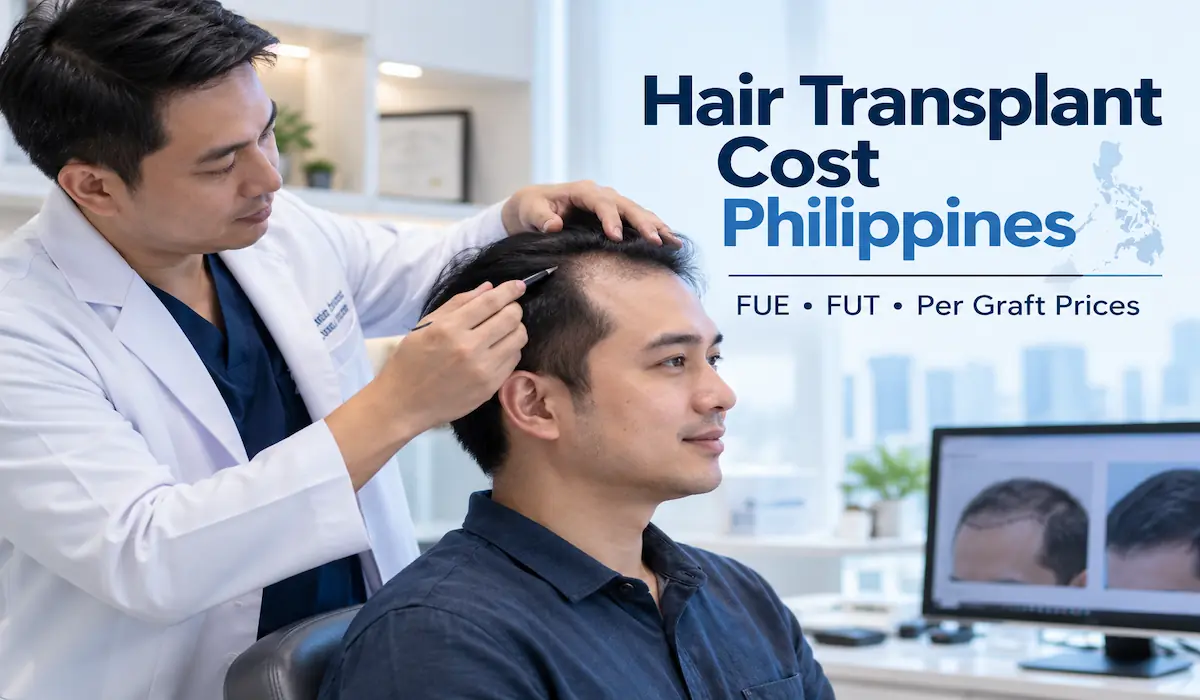
Hair Transplant Cost in the Philippines 2026: FUE, FUT & Prices Per Graft
Quick answer: A hair transplant in the Philippines generally costs around ₱70,000–₱300,000 or more, based on published estimates from Philippine clinics. FUT (strip surgery) is often quoted at approximately ₱70,000–₱200,000, while FUE commonly has published estimates of ₱120,000–₱250,000+. Larger or premium procedures can cost substantially more: Clinique de Paris advertises DHI packages starting at ₱250,000 for 2,000 hairs, while surgeons interviewed by Philstar in August 2026 discussed procedures costing ₱300,000–₱400,000. The final price depends on the number of grafts, technique, surgeon, and services included.
When it is used: A hair transplant is a surgical procedure that moves healthy hair follicles from a donor area, usually the back or sides of the scalp, to thinning or bald areas. It is most commonly used to restore a receding hairline or areas affected by permanent pattern hair loss, also called androgenetic alopecia. Selected patients may also undergo hair transplantation to restore eyebrows, beards, or areas affected by scarring. The procedure does not create new follicles or stop ongoing hair loss, so some patients need other treatments to preserve their existing hair.
Hair Transplant Cost Philippines: Quick Price Comparison
| Procedure or treatment | Price |
|---|---|
| FUT hair transplant | ₱70,000–₱200,000 |
| FUE hair transplant | ₱120,000–₱250,000+ |
| Small FUE session, 500 grafts | ₱75,000 |
| FUE session, 2,000 grafts | ₱170,000 |
| FUT session, 2,000 grafts | ₱140,000 |
| DHI hair transplant | From ₱250,000 |
| Premium specialist surgery | ₱300,000–₱400,000 |
| Extensive premium hair transplant | Up to ₱750,000 in a published clinic estimate |
These prices come from different sources and billing models. They are not official Philippine averages, and the graft-based figures are calculations rather than guaranteed all-inclusive surgical quotations.
For budgeting: A patient considering a medium-sized FUE procedure might begin comparing quotations around ₱150,000–₱250,000, while a larger premium procedure may require ₱300,000 or considerably more.
Hair Transplant Cost by Number of Grafts
The number of grafts needed is one of the biggest factors affecting hair transplant cost. A hair graft, or follicular unit, is a small group of follicles containing about 1 to 4 individual hairs, though the number varies. Many clinics charge according to how many grafts are transplanted.
The following table combines published FUE volume tiers from MAXIM Hair Restoration with FUT rates appearing in Manzanares Hair Restoration Center’s publicly circulated price information.
| Number of grafts | FUE graft-charge example | FUT graft-charge example |
|---|---|---|
| 500 grafts | ₱75,000 | ₱60,000 |
| 1,000 grafts | ₱120,000 | ₱100,000 |
| 1,500 grafts | ₱150,000 | ₱120,000 |
| 2,000 grafts | ₱170,000 | ₱140,000 |
| 2,500 grafts | ₱212,500 | ₱175,000 |
| 3,000 grafts | ₱240,000 | Not published in the cited FUT tiers |
| 3,500 grafts | ₱262,500 | Not published in the cited FUT tiers |
| 3,900 grafts | ₱292,500 | Not published in the cited FUT tiers |
How to read this table: These are calculations from advertised per-graft tiers, not one clinic’s combined FUE/FUT quotation. MAXIM directly publishes the FUE-style price tiers on its official website. The FUT examples are based on Manzanares’s publicly advertised rates, which were not independently confirmed as current October 2026 quotations.
The totals do not establish whether laboratory tests, medicines, consultations, or aftercare are included.
How much is a 2,000-graft hair transplant?
Using the published price tiers:
- FUE: 2,000 × ₱85 = ₱170,000
- FUT: 2,000 × ₱70 = ₱140,000
The difference is ₱30,000 in these examples. That does not mean FUT will always be ₱30,000 cheaper. Individual clinics may use different pricing structures, and the two techniques have different surgical considerations.
How much is a 3,000-graft hair transplant?
At MAXIM’s published volume rate of ₱80 per graft:
3,000 grafts × ₱80 = ₱240,000
This is a useful benchmark for comparing quotations, not a confirmed final bill for every 3,000-graft patient.
Hair Transplant Price Per Graft in the Philippines
A per-graft price list helps explain why the total cost can increase even when the price of each graft decreases.
Published FUE price tiers
| Graft count | Advertised price per graft |
|---|---|
| 300–500 | ₱150 |
| 600–1,000 | ₱120 |
| 1,100–1,900 | ₱100 |
| 2,000–2,600 | ₱85 |
| 2,700–3,400 | ₱80 |
| 3,500–3,900 | ₱75 |
MAXIM Hair Restoration Philippines publishes these volume-based graft rates in its online price guide.
The pricing page does not clearly define a rate for every gap between the listed volume brackets or every package inclusion. Ask for an exact quotation rather than extrapolating an undefined tier.
Published Manzanares FUT price
| Graft count | Advertised FUT price per graft |
|---|---|
| 300–500 | ₱120 |
| 600–1,000 | ₱100 |
| 1,100–1,900 | ₱80 |
| 2,000–2,600 | ₱70 |
These amounts appear in publicly accessible Manzanares Hair Restoration Center promotional material. The current validity, inclusions, and eligibility of the rates should be confirmed directly with the clinic before using them as a booking price.
Why larger procedures may have a lower rate per graft
A clinic may offer volume-based pricing because a larger session spreads certain fixed costs over more grafts. For example, in MAXIM’s published schedule, the rate drops from ₱150 per graft for a 300–500-graft session to ₱85 per graft for a 2,000–2,600-graft session.
However, more grafts are not automatically better. The donor area has a limited supply of hair. Removing too many follicles can cause visible thinning, scarring, and reduced options for future treatment.
A qualified surgeon should determine how many grafts can be safely transplanted rather than recommending an unnecessarily large session because the per-graft price is lower.
Hair Transplant Clinic Prices in the Philippines
Many Philippine clinics provide a final surgical price only after examining the patient’s scalp. These are the published examples that can be traced to identifiable providers or named specialists.
| Clinic or source | Location | Publicly available price information |
|---|---|---|
| MAXIM Hair Restoration | Makati and Cebu | Published graft tiers of ₱75–₱150 |
| Manzanares Hair Restoration Center | Ortigas, Pasig | Publicly advertised FUE/FUT graft tiers; latest validity requires confirmation |
| Clinique de Paris | Makati | ₱250,000 starting package for 2,000 hairs |
| Svenson Hair Centers | Multiple Philippine locations | Publishes general FUE and FUT cost estimates; individual clinic quotation required |
| Asian Hair Restoration Center physicians | Mandaluyong | ₱300,000–₱400,000 discussed in an August 2026 Philstar interview |
MAXIM Hair Restoration Philippines
MAXIM has published pricing information for both the total cost of hair transplants and different graft volumes. Its price guide presents overall Philippine transplant estimates of roughly ₱80,000–₱300,000 or more, alongside per-graft tiers.
The clinic operates in Metro Manila and Cebu. The number of grafts required, surgical technique, and actual inclusions must still be determined during consultation.
Manzanares Hair Restoration Center
Manzanares is a hair restoration provider based in Ortigas Center, Pasig City. The clinic has published information describing both FUE and FUT techniques. Public promotional posts also contain separate price-per-graft tiers for these methods.
For a patient comparing a 2,000-graft procedure, those advertised figures give an example of:
- FUE at ₱85 per graft, or ₱170,000
- FUT at ₱70 per graft, or ₱140,000
Because promotional rates can change, request the clinic’s current written price schedule before relying on these figures.
Clinique de Paris
Clinique de Paris in Makati publishes a starting DHI hair transplant package of: ₱250,000 for 2,000 hairs. Its package description states that the starting price includes:
- Use of the procedure facility
- Preoperative assessments and blood tests
- Postoperative medications and materials
- A platelet mesotherapy booster treatment
The clinic has also published a broader price range of approximately ₱250,000–₱750,000, depending on the treatment plan.
Important: Clinique de Paris counts individual hairs, not simply follicular-unit grafts. Its 2,000-hair package is not equivalent to a 2,000-graft package.
Svenson Hair Centers
Svenson’s January 2026 hair transplant pricing guide gives these general estimates:
- FUE: ₱120,000–₱250,000
- FUT: ₱70,000–₱200,000
- Facial hair transplantation: ₱80,000–₱150,000
These are general price ranges presented in Svenson’s educational guide, not confirmed fixed quotations for individual Svenson clinics. Its actual services and charges depend on consultation and the recommended treatment.
Asian Hair Restoration Center
An August 23, 2026 Philstar interview with hair-restoration physicians Dr. Julieta Peralta Arambulo and Dr. Mariel Arambulo Cordero provides another useful real-world price reference.
The report states that hair transplantation at their practice can cost approximately ₱300,000–₱400,000, depending on technique.
It also describes a ₱6,500 scalp and hair assessment using trichoscopy. These figures illustrate how specialist assessment and premium surgical services can differ from lower-cost graft-based offers. They are reported interview prices, not a nationwide price list.
FUE vs. FUT vs. DHI: Which Is Better for Your Budget?
The difference between techniques is not only the cost. The donor-harvesting method, scarring, procedure planning, and suitability for future hair loss all matter.
| Feature | FUE | FUT | DHI |
|---|---|---|---|
| Full name | Follicular Unit Excision/Extraction | Follicular Unit Transplantation | Direct Hair Implantation |
| Main approach | Individual graft harvesting | Strip harvesting | Describes a graft implantation approach |
| Donor scarring | Multiple small extraction scars | Usually a linear scar | Depends on harvesting technique |
| Pricing | Often higher than FUT | Often lower than FUE | Can be marketed as a premium package |
| Important question | How many grafts can be safely removed? | What scar and donor closure should I expect? | How are grafts harvested and implanted? |
FUE hair transplant
FUE involves removing individual follicular units from the donor area with small surgical punches. It is often preferred by patients who want to avoid a long linear scar.
However, FUE is not scar-free. Small extraction scars remain in the donor area, although their visibility varies. FUE often takes significant surgical time when many grafts are needed, contributing to its cost.
FUT hair transplant
FUT involves removing a strip of hair-bearing scalp from the donor area. That strip is then divided into follicular-unit grafts for transplantation. FUT can provide a substantial number of grafts without making thousands of separate donor extraction sites.
Its main disadvantage is the linear donor scar, which can be more visible with very short hairstyles. The suitability of FUT depends on factors such as donor density, scalp characteristics, and the surgeon’s long-term plan.
DHI hair transplant
DHI is commonly used to describe methods of placing grafts directly into recipient areas, sometimes with specialized implanter instruments.
According to the International Society of Hair Restoration Surgery (ISHRS), DHI is not a distinct donor-harvesting method in the same sense as FUE or FUT.
If a clinic advertises DHI as a separate technique, ask exactly how the grafts are extracted, who makes recipient incisions, and what the quoted price includes. Do not assume the highest-priced technique automatically produces the highest graft survival or best result.
How Many Grafts Do You Need?
Hair-loss severity alone cannot determine the exact number of grafts. The surgeon must assess the size of the treatment area, existing hair density, hair characteristics, and usable donor supply.
For early planning, clinics sometimes use broad graft-count groupings:
| Treatment scope | Illustrative planning range |
|---|---|
| Small hairline correction | Around 500–1,000 grafts |
| Hairline and temple restoration | Around 1,000–1,500 grafts |
| Moderate frontal thinning | Around 1,500–2,500 grafts |
| Larger frontal and crown areas | 2,500–4,000+ grafts may be considered |
These are rough planning examples, not prescribed graft counts. Two patients with the same visible hair-loss pattern can require substantially different treatment plans.
Can you transplant 4,000 grafts in one session?
Some clinics advertise sessions involving up to 4,000 grafts, but not every patient has enough donor follicles for a session of that size. The surgeon should explain whether the number is realistic and what effect it could have on the donor area. A staged procedure may be more appropriate in some cases.
Grafts vs. Hairs: Avoid This Expensive Comparison Mistake
A graft and a hair are not the same unit. One graft is a follicular unit that may contain one, two, three, or several hairs. For example, a quotation for 2,000 grafts could represent several thousand individual hairs, depending on the actual follicular composition.
A package for 2,000 hairs may contain fewer than 2,000 grafts. This matters when comparing a per-hair premium package with a per-graft quote.
Before paying a deposit, ask every clinic to clarify:
- How many individual hairs are estimated?
- How many follicular-unit grafts are planned?
- Which number determines the bill?
- What happens if the final implanted count differs from the original estimate?
A quote should be understandable without guessing which unit is being used.
Hair Transplant Cost in Manila vs. Cebu
Metro Manila offers several established hair-restoration providers, particularly in Makati, Pasig, and Mandaluyong. Cebu also has specialized hair-transplant services, including MAXIM’s Cebu location.
However, there are not enough comparable public quotations to establish a reliable Manila-wide or Cebu-wide average. A clinic in Makati is not necessarily more expensive than every clinic in Cebu, and pricing may depend more on the surgeon and treatment scope than location.
For patients traveling from outside the treatment city, the total budget should include transportation, accommodation, and access to follow-up care.
What Is Included in a Hair Transplant Package?
A lower-priced quote is not necessarily cheaper after all surgical and recovery expenses are included. Always ask for the full amount in writing.
| Cost component | What to confirm |
|---|---|
| Consultation and scalp assessment | Included or separately charged? |
| Surgeon and surgical team | Are professional fees included? |
| Graft extraction and implantation | What graft count is covered? |
| Local anesthesia | Included in the quoted price? |
| Procedure room and equipment | Are facility charges included? |
| Preoperative blood tests | Which tests are covered? |
| Postoperative medicines | Are medicines and dressings included? |
| Follow-up appointments | How many visits are included? |
| PRP or mesotherapy | Optional add-on or part of the package? |
| Touch-up or revision | Is any further work included? |
Extra charges that may affect the final amount
Some procedures require preoperative laboratory testing or treatment of an existing scalp condition. Optional add-on services may also increase the bill.
For example, Svenson’s January 2026 market guide estimates PRP hair treatment at approximately ₱5,000–₱20,000 per session, although that does not mean every clinic recommends PRP or charges within that range.
Hair-loss medicines and future follow-up treatment can also create continuing expenses. Do not add every possible service to your budget automatically. Ask the surgeon which expenses are medically necessary for your case.
The Long-Term Cost of Hair Restoration
A hair transplant may restore coverage in selected areas, but it does not guarantee that surrounding non-transplanted hair will remain unchanged. A patient who pays ₱170,000 for a procedure may later spend more on:
- Prescribed treatment to manage ongoing hair loss
- Monitoring and follow-up consultations
- Additional hair-restoration procedures if hair loss progresses
- Optional cosmetic maintenance treatments
These future expenses are not mandatory for everyone. The important point is to consider whether the surgeon’s proposed hairline and graft plan will remain reasonable as the patient ages.
A design that looks very dense immediately after transplantation may not be sustainable if it uses too many donor grafts and future hair loss continues.
Does PhilHealth Cover Hair Transplant Surgery?
Routine elective cosmetic hair transplantation should be treated as an out-of-pocket expense. Philippine National Health Insurance legislation identifies cosmetic surgery among excluded personal health services, subject to the law’s provisions on possible inclusion of particular benefits.
CareCostPH did not identify a current dedicated PhilHealth benefit package for ordinary cosmetic hair transplantation used to treat pattern baldness.
If surgery is proposed for reconstructive reasons after an injury, burn, or another medical condition, ask the treating hospital and PhilHealth to verify whether any specific covered service applies. Do not assume that a standard private hair transplant qualifies for reimbursement.
Does an HMO Cover Hair Transplants?
Most ordinary HMO plans do not automatically cover elective cosmetic procedures. However, a medically indicated dermatology consultation or diagnostic assessment may be covered under some plans. Ask your insurer whether the following are included:
- Consultation with a dermatologist
- Medical investigation of hair loss
- Relevant laboratory tests
- Reconstructive treatment, if applicable
Get written confirmation before booking an expensive procedure.
Do Senior Citizen and PWD Discounts Apply?
Do not automatically deduct 20% from the price of an elective cosmetic hair transplant. Philippine senior citizen discount rules distinguish medically necessary treatment from procedures performed solely for cosmetic purposes.
The application of PWD benefits also depends on the relevant legal requirements and the nature of the service. Ask the clinic for an itemized bill and clarification of any legally applicable discount. Do not assume a cosmetic operation qualifies solely because it is performed at a medical facility.
Is Hair Transplant Surgery Safe?
Hair transplantation involves surgical incisions, local anesthesia, and the handling of living hair follicles. Possible complications include:
- Infection or bleeding
- Visible scarring
- Poor graft growth or survival
- An unnatural hairline
- Patchy growth or uneven density
- Overharvesting and thinning of the donor area
- Persistent discomfort or altered scalp sensation
The skill and qualifications of the operating physician matter significantly. The ISHRS advises patients to verify the credentials of the physician responsible for diagnosis, hairline design, harvesting, surgical incisions, and aftercare.
How to check a clinic before booking
Request the full name of the surgeon who will actually perform or lead the surgery. Verify the physician’s registration through the Professional Regulation Commission.
Ask about their relevant surgical training, experience with your type of hair loss, and who will perform each important step. Review authentic patient results with similar hair-loss patterns rather than relying only on advertisements.
Avoid promises such as guaranteed graft survival, no possibility of scarring, or an unlimited number of grafts.
Recovery: How Long Before You See Results?
Hair transplantation is often performed as an outpatient procedure using local anesthesia. The actual session length depends on the technique and number of grafts. A substantial procedure can take several hours.
First days after surgery
Temporary redness, swelling, tenderness, and small scabs may occur. Patients receive instructions about cleaning the scalp, sleeping, activity restrictions, and medicines.
First few weeks
Some transplanted hair shafts may shed after surgery. This does not automatically mean the transplanted follicles have failed.
Following months
New hair growth usually develops gradually. Many patients notice meaningful improvement over several months, while a fuller assessment of the result generally requires 6–12 months or longer.
Results vary, especially in crown restoration and larger procedures. Do not evaluate the final success of a hair transplant solely from how the scalp looks a few weeks after surgery.
Is a Hair Transplant Permanent?
Transplanted follicles taken from suitable donor areas can provide long-lasting hair growth. However, the durability of the result depends on individual hair characteristics, graft survival, and continuing hair loss.
A transplant moves follicles; it does not cure the underlying tendency toward pattern baldness. The non-transplanted hair may continue thinning, which is why the surgeon should discuss the long-term treatment plan before operating.
Is It Cheaper to Get a Hair Transplant Abroad?
Countries such as Turkey advertise hair-transplant packages to international patients. Some overseas offers can look cheaper than premium Philippine clinic prices. But a useful comparison must include more than the advertised surgical amount:
- Airfare and local transportation
- Hotel accommodation
- Time away from work
- Included medicines and postoperative checks
- Travel restrictions after surgery
- Access to follow-up care if complications occur
- Whether the operating surgeon’s credentials can be verified
A lower overseas package price does not necessarily mean the total expense or medical risk is lower. For a Filipino patient, the ability to return easily to a local physician for follow-up may be an important practical advantage.
Cheaper Alternatives to Hair Transplant Surgery
Some patients may benefit from non-surgical hair-loss treatments before considering transplantation. A dermatologist can help identify whether the hair loss is due to pattern baldness, a scalp condition, an underlying health issue, or another cause.
| Alternative | How it differs from a transplant |
|---|---|
| Topical minoxidil | May help certain patients maintain or improve hair growth |
| Prescription finasteride | May be appropriate for certain patients with pattern hair loss; requires medical assessment |
| PRP treatment | Optional procedural treatment with variable evidence and results |
| Scalp micropigmentation | Cosmetic pigmentation that creates the appearance of fuller hair |
| Hairpieces or hair systems | Non-surgical cosmetic replacement |
| Treatment of an underlying condition | May help when hair loss has an identifiable medical cause |
These approaches have different costs, benefits, risks, and maintenance requirements. Do not assume every new treatment advertised for hair restoration has the same evidence as established treatments.
Hair Transplant Installment and Financing Options
Some clinics advertise installment or financing arrangements, although availability and terms vary. Before choosing an installment plan, request:
- Total cash price
- Required initial payment
- Number of installments
- Interest and financing charges
- Late payment penalties
- Cancellation and refund terms
- Total amount payable after financing
A low monthly payment does not necessarily mean the total surgical cost is low. Compare both the financing terms and the medical quality of the service.
Frequently Asked Questions
Magkano ang hair transplant sa Pilipinas?
Published Philippine clinic estimates place many hair transplant procedures around ₱70,000–₱300,000 or more. Premium clinics and extensive operations can exceed that range.
How much is FUE hair transplant in the Philippines?
Svenson’s 2026 guide estimates ₱120,000–₱250,000 for FUE. Other clinics publish price-per-graft schedules or charge a personalized package fee.
How much is FUT hair transplant?
A published Philippine estimate is ₱70,000–₱200,000. Manzanares’s advertised FUT tiers also provide calculated examples such as ₱140,000 for 2,000 grafts, subject to rate confirmation.
How much does one hair graft cost in the Philippines?
In the reviewed price schedules, advertised graft rates range from ₱70 to ₱150 across FUT and FUE examples. These are not universal prices for every clinic.
How much does a 1,000-graft transplant cost?
Using the reviewed tiers, the calculated charge is ₱120,000 for FUE or ₱100,000 for FUT. The final bill depends on the provider’s current price and package inclusions.
How much does a 2,000-graft transplant cost?
The illustrative calculations are ₱170,000 for FUE and ₱140,000 for FUT. The FUT calculation uses a publicly advertised rate whose current availability should be confirmed.
Is FUT cheaper than FUE?
Often, yes, according to published clinic estimates. However, the technique should be selected according to donor characteristics, scarring, surgical suitability, and long-term goals, not price alone.
Is DHI better than FUE?
DHI is a term used for certain graft implantation approaches rather than a separate graft-harvesting category. The suitability and outcome depend on the whole surgical plan, including who performs the procedure.
Is an eyebrow or beard transplant cheaper?
It may involve fewer grafts than a large scalp transplant, but specialist facial hair placement can have its own pricing. Clinique de Paris’s published 2025 service menu lists eyebrow transplantation starting at ₱175,000 and beard transplantation starting at ₱200,000, showing that a smaller treatment area is not automatically inexpensive.
Is a hair transplant permanent?
Transplanted hair can be long-lasting, but surrounding natural hair may continue to thin. Some patients require further treatment.
How long does a hair transplant procedure take?
A session commonly lasts several hours, depending on graft count, technique, and the surgical team. Your clinic should provide an estimated schedule before surgery.
Can women get hair transplants?
Yes, some women are suitable candidates. However, the cause and distribution of hair loss must be assessed because not all forms of female hair thinning are appropriate for transplantation.
Does PhilHealth cover cosmetic hair transplant surgery?
A routine elective cosmetic hair transplant should not be assumed to qualify for PhilHealth reimbursement. Ask for verification if surgery is being considered for a specific reconstructive medical indication.
Before You Pay a Deposit: Hair Transplant Clinic Checklist
Ask these questions during your consultation:
- Who is the surgeon, and what are their qualifications?
- Who will perform graft harvesting and surgical incisions?
- How many grafts are recommended, and why?
- Is the price based on grafts or individual hairs?
- Will I pay for the planned number or actual number transplanted?
- Why is FUE, FUT, or a particular implantation technique recommended?
- How will the donor area look after surgery?
- What is included in the written quotation?
- Are medicines, laboratory tests, and follow-ups extra?
- Can I see authentic before-and-after cases comparable to mine?
- What happens if the expected result is not achieved?
- What are the deposit, cancellation, and refund policies?
Key price takeaway: For a moderate hair transplant in the Philippines, a comparison budget of around ₱150,000–₱250,000 is reasonable based on the published examples reviewed. Smaller procedures may cost less, while complex or premium surgery may exceed ₱300,000. Before booking, obtain a personalized written quote and verify the surgeon who will perform the operation.
How CareCostPH Checked These Prices
CareCostPH reviewed available hair-transplant pricing from Philippine clinic websites, publicly advertised provider rates, medical society guidance, Philippine legal sources, and a 2026 interview with hair-restoration specialists.
Prices were reviewed against available sources on October 15, 2026.
The figures in this article have different evidence types: direct clinic starting prices, provider-published market estimates, publicly advertised promotional tiers, reported specialist price examples, and arithmetic calculations. They should not be interpreted as interchangeable.
CareCostPH did not visit or call the clinics, request a personalized surgical quotation, or independently verify the graft counts of actual patients.
Medical and pricing note: This article provides general cost information and does not replace evaluation by a qualified physician. Prices, financing offers, and package inclusions can change. Hair transplantation involves surgical risks and is not suitable for every type of hair loss.