6-in-1 Vaccine for Baby Price Philippines 2026: Per Dose, 3 Doses & Free Alternatives
Quick answer: A 6-in-1 (hexavalent) vaccine for babies costs about ₱3,150 to ₱5,175 per dose at Philippine vaccine sellers, private clinics, and booking providers, based on published prices reviewed by CareCostPH. Several clinic and vaccination-center listings charge around ₱3,850–₱4,350 per dose, while some advertise higher regular prices of up to ₱6,500.
Three primary doses cost approximately ₱9,450–₱15,525 at these listed rates. If the pediatrician also uses a 6-in-1 vaccine for a later booster, four doses would cost ₱12,600–₱20,700 before separate fees. The 6-in-1 combination is not routinely free at government health centers, but the DOH provides free pentavalent and polio vaccines that protect against the same six diseases.
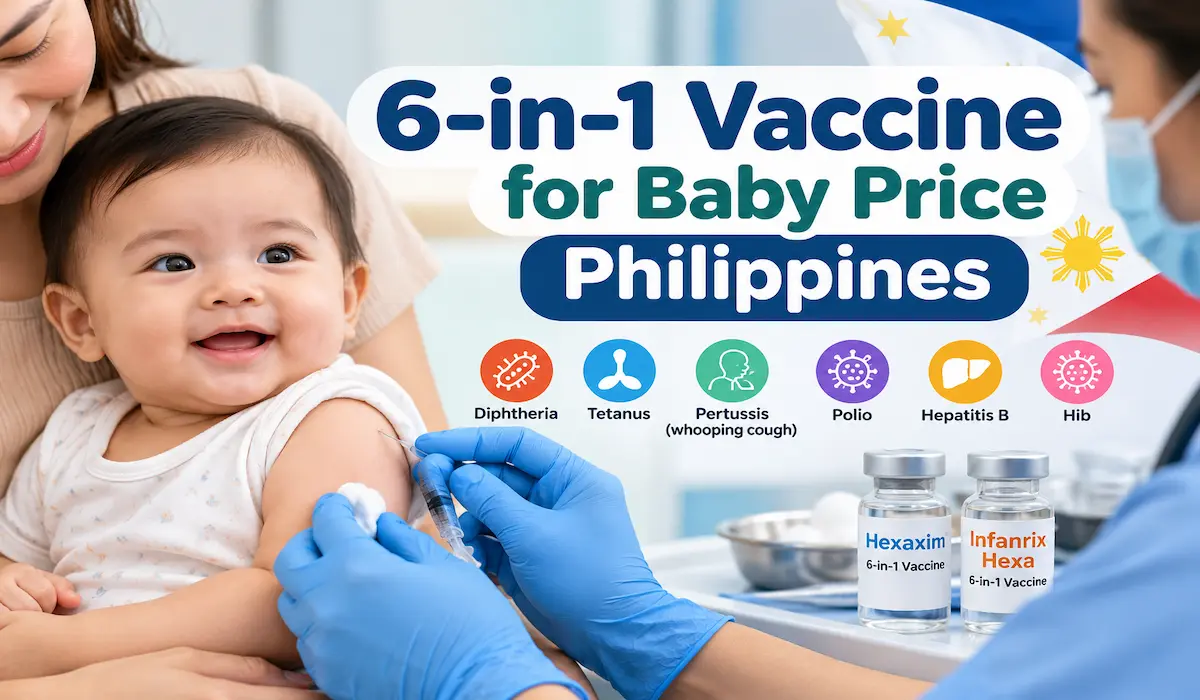
When it is used: The 6-in-1 vaccine protects babies against diphtheria, tetanus, pertussis (whooping cough), polio, hepatitis B, and Haemophilus influenzae type b (Hib), which can cause serious infections such as meningitis and pneumonia. It combines protection against six diseases into one injection, reducing the number of separate shots needed during infant vaccination.
Pediatricians use hexavalent vaccines in the primary immunization series beginning as early as six weeks of age, with later booster vaccination planned according to the child’s history. It is an alternative way to deliver scheduled vaccine components, not an additional vaccine that every child needs on top of all the corresponding government doses.
6-in-1 Vaccine Price in the Philippines
| Vaccine or Option | Published Price |
|---|---|
| 6-in-1 vaccine, single dose | ₱3,150–₱5,175 |
| Private vaccine center promotional rates | ₱3,850–₱4,350 |
| Higher advertised regular price | Up to ₱6,500 |
| Three primary doses | ₱9,450–₱15,525 |
| Three doses plus one 6-in-1 booster | ₱12,600–₱20,700 |
| Government pentavalent + polio vaccines | Free |
The figures come from selected published Philippine listings, including promotional and vaccine-product prices. They are not official national average prices. Calculated totals assume the same price for each dose and exclude separately billed services.
Actual 6-in-1 Vaccine Prices by Clinic and Provider
Parents can find published 6-in-1 prices through vaccination centers, private clinics, and online appointment platforms.
| Provider | Location / Price Type | Price Per Dose |
|---|---|---|
| LealMeds | Online Infanrix 6-in-1 product listing | ₱3,150 |
| Vaxcen | Vaccination-center promotional listing | ₱3,850 |
| Pallad Health | Lipa City, Batangas — Hexaxim | ₱4,000 |
| Caliwag Medicore | Pediatric immunization booking | ₱4,000 |
| Hati Health | Infanrix Hexa booking promotion | ₱4,000 |
| Vaxcen through Hati Health | Quezon City / Mandaluyong | From ₱4,350 |
| Balbido Medical Clinic through Hati | Makati / Muntinlupa | ₱5,175 |
Where is the 6-in-1 vaccine cheapest?
The lowest published amount among these listings is ₱3,150 at LealMeds. However, that is an online product listing, and parents should confirm whether professional administration and consultation are included or charged separately.
For an advertised vaccination service, Vaxcen’s ₱3,850 promotional price is one of the lower published examples. Pallad Health lists Hexaxim at ₱4,000, while Caliwag Medicore’s pediatric immunization booking also displays ₱4,000.
Vaxcen separately advertises a regular reference price of ₱6,500 beside its discounted ₱3,850 price. The higher figure should not be mistaken for its current promotional selling price.
Practical takeaway: Comparing the final administered cost is more useful than comparing vaccine product prices alone. A cheaper listing may not be the cheapest appointment if the consultation, administration, or transportation costs are higher.
How Much Does the Full 6-in-1 Vaccine Series Cost?
Most infant schedules using DTP-containing combinations include three primary doses, followed by booster vaccination later. Not every baby needs the hexavalent combination for the booster itself. A pediatrician may select a different DTP-containing combination based on the child’s previous doses and the product’s approved indications.
Three-dose primary series cost
| Price Per Dose | Total for 3 Doses |
|---|---|
| ₱3,150 | ₱9,450 |
| ₱3,850 | ₱11,550 |
| ₱4,000 | ₱12,000 |
| ₱4,350 | ₱13,050 |
| ₱5,175 | ₱15,525 |
These are mathematical totals at unchanged per-dose prices, not verified prepaid packages.
What if your pediatrician uses four 6-in-1 doses?
| Price Per Dose | 3 Primary Doses + 1 Booster |
|---|---|
| ₱3,150 | ₱12,600 |
| ₱3,850 | ₱15,400 |
| ₱4,000 | ₱16,000 |
| ₱4,350 | ₱17,400 |
| ₱5,175 | ₱20,700 |
A four-dose plan at a clinic charging ₱4,000 per visit would therefore cost ₱16,000 for the vaccine charges, assuming the fourth dose is also hexavalent and the price stays the same.
The fourth vaccination may instead use a different combination, such as DTaP-IPV-Hib, depending on what the child needs. Ask for the planned booster product before estimating the full cost.
A second DTP-containing booster is also recommended at approximately 4–6 years old. That later booster generally uses an age-appropriate combination rather than the infant 6-in-1 product.
6-in-1 vs 5-in-1 vs Government Pentavalent Vaccine
The names can be confusing because private 5-in-1 and government pentavalent vaccines do not necessarily contain the same components.
| Vaccine | Diseases Covered | Pertussis Component | Availability |
|---|---|---|---|
| 6-in-1 (hexavalent) | Diphtheria, tetanus, pertussis, polio, hepatitis B, Hib | Acellular (aP) | Private clinics |
| Private 5-in-1 (DTaP-IPV-Hib) | Diphtheria, tetanus, pertussis, polio, Hib | Acellular (aP) | Private clinics |
| DOH pentavalent (DTwP-HepB-Hib) | Diphtheria, tetanus, pertussis, hepatitis B, Hib | Whole-cell (wP) | Government health centers |
The difference is important:
- The private 6-in-1 contains both hepatitis B and polio components.
- The private DTaP-IPV-Hib 5-in-1 contains polio but not hepatitis B.
- The government pentavalent contains hepatitis B but not polio. The health center provides polio vaccines separately.
This means the free government vaccination route covers the same six diseases without using the hexavalent combination.
How much does a private 5-in-1 cost?
Vaxcen advertises a private 5-in-1 DTaP-IPV-Hib vaccine at ₱3,250, discounted from a listed regular price of ₱5,500. Hati Health lists a private 5-in-1 pediatric vaccine at ₱3,800 through participating providers.
A cheaper private 5-in-1 shot does not automatically make the entire immunization plan cheaper, because hepatitis B protection still needs to be accounted for.
Hexaxim vs Infanrix Hexa: Brand and Price Comparison
Two well-known 6-in-1 brands used in the Philippines are Hexaxim and Infanrix Hexa. Both provide protection against the same six diseases, but their formulations and preparation differ.
| Feature | Hexaxim | Infanrix Hexa |
|---|---|---|
| Manufacturer | Sanofi | GSK |
| Vaccine type | Hexavalent DTaP-HepB-IPV-Hib | Hexavalent DTaP-HepB-IPV-Hib |
| Presentation | Ready-to-use liquid formulation | Liquid component plus Hib powder requiring reconstitution |
| Published price example | ₱4,000 at Pallad Health | ₱4,000 promotional via Hati Health |
These two price examples happen to match, but they do not establish that the brands cost the same nationwide.
Both are designed to provide immunity against the same diseases. The decision about which brand to use should be based on the infant’s age, prior immunizations, vaccine availability, and the pediatrician’s assessment.
Is the 6-in-1 vaccine really “painless”?
Parents sometimes call the private 6-in-1 the “painless vaccine.” This nickname refers mainly to its acellular pertussis component, which is generally associated with fewer mild reactions than the whole-cell pertussis component used in government pentavalent vaccines.
However, the 6-in-1 injection still hurts. Your baby can still experience brief injection pain, local swelling, mild fever, fussiness, or other temporary reactions. The nickname should not be interpreted as a guarantee of no pain or side effects.
Is the 6-in-1 Vaccine Free at Barangay Health Centers?
No routine free hexavalent 6-in-1 combination was identified under the Philippine National Immunization Program. Government health centers instead provide separate vaccines to protect against the same diseases.
Free vaccines available at government health centers
| Government Vaccine | Protection | Cost |
|---|---|---|
| Pentavalent vaccine | Diphtheria, tetanus, pertussis, hepatitis B, Hib | Free |
| Oral polio vaccine (OPV) | Polio | Free |
| Inactivated polio vaccine (IPV) | Polio | Free |
The vaccines follow the government immunization schedule. They are not necessarily given at exactly the same visits as a private hexavalent schedule.
Why does the government use separate vaccines?
The DOH National Immunization Program uses pentavalent and polio vaccines rather than routinely purchasing the more expensive private hexavalent combination. In March 2025, the Philippine Health Technology Assessment Council issued a preliminary recommendation against government financing of hexavalent vaccines.
Its published cost comparison estimated substantially higher national expenditure for hexavalent vaccination than for the existing pentavalent-plus-IPV approach. The council acknowledged that hexavalent vaccines could simplify immunization visits, but recommended prioritizing the existing program at the prices evaluated.
For parents, the important point is that choosing the free government program does not mean foregoing protection against the six diseases. If private vaccination is unaffordable, visit your barangay health station or rural health unit to arrange the government vaccines on time.
6-in-1 Vaccine Schedule for Babies in the Philippines
The revised July 2026 Philippine childhood immunization schedule, published by the Philippine Pediatric Society, Pediatric Infectious Disease Society of the Philippines, and Philippine Foundation for Vaccination, recommends a three-dose DTP-containing primary series and later boosters.
A recognized early infant schedule begins at six weeks.
| Vaccination Stage | Example Age |
|---|---|
| First primary dose | 6 weeks |
| Second primary dose | 10 weeks |
| Third primary dose | 14 weeks |
| First DTP-containing booster | 12–18 months |
| Later DTP-containing booster | 4–6 years |
Private pediatricians may instead use a schedule such as 2, 4, and 6 months, depending on the chosen product and the baby’s immunization history.
The minimum interval for a routine three-dose DTP-containing primary series is generally four weeks.
For the later booster, the exact vaccine combination matters. The pediatrician may use a DTaP-containing booster with or without additional components rather than automatically repeating all six antigens.
Does a newborn need hepatitis B at birth even with 6-in-1?
Yes. Hexavalent vaccination should not replace the recommended monovalent hepatitis B birth dose. The birth dose is particularly important because it provides early protection against hepatitis B transmission.
The pediatrician will account for that dose when planning later combination vaccines.
What if your baby missed a 6-in-1 dose?
A delayed or interrupted DTP-containing vaccination series generally does not need to be restarted. Bring the child’s immunization card or baby book to the clinic.
A healthcare professional can determine the appropriate catch-up doses and intervals based on the child’s age and previous vaccinations.
Can You Mix Free Health Center Vaccines With Private 6-in-1 Doses?
Sometimes, yes. Families may change from government to private vaccination or vice versa. However, the products have overlapping components, and switching requires careful review of previous doses.
For example, a child who has already received government pentavalent vaccine and separate polio vaccination may not need exactly the same components repeated.
Before switching:
- Show the pediatrician the complete immunization record.
- Identify which pentavalent, polio, or combination vaccines have already been given.
- Confirm which antigens and doses are still required.
- Follow an appropriate catch-up or continuation schedule.
The goal is to avoid unnecessary repeat doses while ensuring no required vaccine component is missed.
What Additional Costs Should Parents Expect?
The listed vaccine price may not represent the final cost of the visit.
| Possible Extra Charge | When It May Apply |
|---|---|
| Pediatric consultation | If the doctor bills the assessment separately |
| Vaccine administration fee | If the published amount covers the vaccine product only |
| Home vaccination service | If an authorized provider administers it at home |
| Other scheduled vaccines | PCV, rotavirus, or other vaccines at the same visit |
| Later booster | If not included in the original quotation |
For example, Pallad Health publishes a ₱400 consultation fee separately from its ₱4,000 Hexaxim listing. That does not prove every vaccine appointment requires both charges. Parents should ask whether the consultation fee applies to their booking.
The same visit may also include other vaccines that are billed separately.
Does PhilHealth Cover the 6-in-1 Vaccine?
CareCostPH did not identify a standard PhilHealth benefit that directly reimburses parents for purchasing a private hexavalent vaccine dose.
PhilHealth Newborn Care Package
PhilHealth’s Newborn Care Package includes essential newborn services, including hepatitis B and BCG vaccination at birth. However, those services are different from the 6-in-1 vaccine series given later in infancy.
Parents should not assume that the Newborn Care Package pays for privately purchased hexavalent doses.
PhilHealth YAKAP
PhilHealth YAKAP provides eligible primary-care benefits at accredited providers. The private 6-in-1 vaccine is not established as a generally reimbursable standalone vaccination under the published benefits reviewed.
Ask an accredited provider if a particular service is included in your child’s applicable care arrangement.
Government vaccines are free without buying private 6-in-1
Routine DOH vaccinations are provided through public immunization services. Parents do not need to purchase a private hexavalent vaccine to obtain routine government-funded protection against the six diseases.
Does HMO Cover the 6-in-1 Vaccine?
Coverage depends on the HMO or insurance policy. Some plans cover pediatric consultations but exclude vaccination products. Others may provide preventive-care or immunization benefits under specific conditions.
Before booking, ask whether the policy covers:
- The hexavalent vaccine itself
- Pediatric consultation
- Vaccine administration
- The chosen hospital or clinic
- Any required letter of authorization (LOA)
Do not assume that an HMO-accredited pediatrician means the vaccine is automatically covered.
Common Side Effects of the 6-in-1 Vaccine
Hexavalent vaccines can cause temporary reactions, including:
- Pain, swelling, or redness at the injection site
- Mild fever
- Irritability or crying
- Sleepiness
- Reduced appetite
Most mild reactions resolve without complications.
Severe allergic reactions are rare but require immediate medical attention. Seek urgent care if the baby develops difficulty breathing, collapse, or rapidly worsening swelling after vaccination.
Parents should tell the pediatrician about any previous serious vaccine reaction or medical condition before the next dose.
Frequently Asked Questions
Magkano ang 6-in-1 vaccine sa pedia?
Published Philippine prices reviewed by CareCostPH range from ₱3,150 to ₱5,175 per dose. Several private vaccination services advertise rates around ₱3,850–₱4,350. Consultation or other fees may apply separately.
Magkano ang complete 6-in-1 vaccine for baby?
Three primary doses cost approximately ₱9,450–₱15,525 at the observed per-dose prices. If four hexavalent doses are administered at those same rates, the calculated cost is ₱12,600–₱20,700, excluding separate fees. The fourth dose is not automatically a hexavalent vaccine for every baby.
Libre ba ang 6-in-1 vaccine sa health center?
The government does not routinely provide the combined 6-in-1 product free. Instead, health centers provide pentavalent and separate polio vaccines to protect against the same six diseases.
How many doses of 6-in-1 does a baby need?
A common schedule includes three primary doses during infancy, followed by age-appropriate booster vaccination. The booster product may be different from the original 6-in-1 vaccine.
Is 6-in-1 better than the free pentavalent vaccine?
Both approaches can protect against the same six diseases when the appropriate polio vaccines are also given. The private 6-in-1 combines more components into one injection and uses acellular pertussis, while government pentavalent uses whole-cell pertussis and requires separate polio vaccination. The best choice depends on the child’s vaccination history and individual circumstances.
Does 6-in-1 protect against pneumonia?
It protects against Hib infections, which can cause certain types of pneumonia, but it does not replace the pneumococcal vaccine (PCV). Babies still need pneumococcal vaccination according to the recommended schedule.
Does the 6-in-1 include influenza vaccine?
No. Hexavalent vaccination includes Hib, caused by Haemophilus influenzae type b bacteria. Hib is not the influenza virus, and 6-in-1 does not replace seasonal flu vaccination.
Can a baby receive free pentavalent first and private 6-in-1 later?
A pediatrician may be able to combine government and private vaccination schedules appropriately. Bring the baby’s immunization records so the clinician can identify which components have already been received and which are still needed.
What if the health center is out of vaccine stock?
Ask when supplies are expected, whether another public health center can provide the dose, or whether a suitable private option is available. A healthcare worker can help plan catch-up vaccination if a dose is delayed.
Before You Book Your Baby’s 6-in-1 Vaccine
For a family budgeting private vaccination, a published rate of approximately ₱4,000 per dose is a useful example. Three doses at that price cost ₱12,000 before additional fees.
Before paying, ask the clinic:
- Is the vaccine Hexaxim, Infanrix Hexa, or another licensed product?
- Does the advertised price include the pediatric consultation and administration?
- Is the price promotional, and when does the offer end?
- Can the clinic provide the remaining doses at future appointments?
- Which booster vaccine is planned, and will it cost the same?
- Are other vaccines scheduled for the same appointment?
- Will the clinic update the baby’s immunization record?
If private vaccination is beyond your budget, use the free DOH immunization services rather than postponing protection.
How CareCostPH Checked These Prices
On October 23, 2026, CareCostPH reviewed publicly available prices from Philippine vaccination providers and official pediatric immunization guidance.
Prices come from selected facilities and booking services. Some listings are promotional, and others do not state when their rates became effective. Figures should not be interpreted as a nationwide standard or average.
CareCostPH did not call, interview, or visit vaccine providers for this review.
Prices are for general information and may change. Confirm the current rate, vaccine brand, availability, and included services with your chosen clinic. Your child’s vaccine schedule should be reviewed by a qualified pediatric healthcare professional.