
DNA Test Price in the Philippines: Paternity, Legal & Prenatal Costs
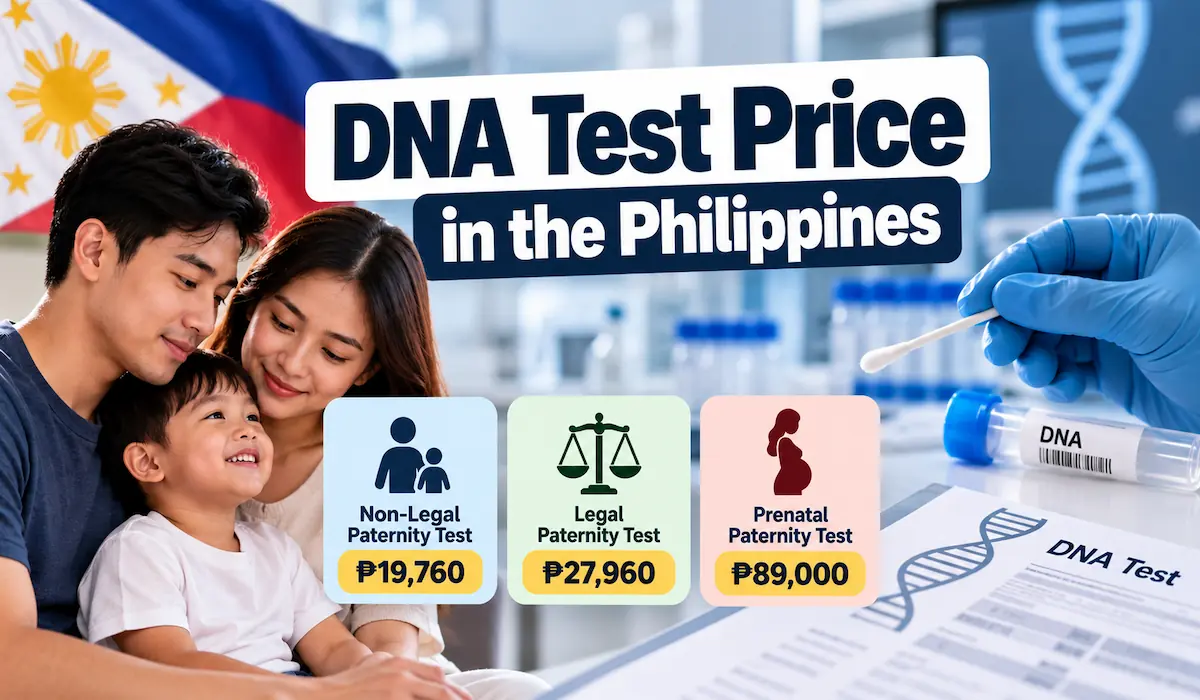
A DNA paternity test in the Philippines costs ₱14,800–₱19,760 among the private testing providers. For a legal paternity test, published prices range from ₱21,800 to ₱34,900, while a prenatal paternity test performed during pregnancy costs ₱75,000–₱89,000.
The biggest factor affecting the price is why you need the DNA test. A private test for personal knowledge is usually cheaper than a legally documented test intended for court proceedings, child support, inheritance or immigration.
DNA Test Price Philippines: Quick Comparison
| DNA test type | Published price | What it’s for |
|---|---|---|
| At-home paternity test | ₱14,800–₱15,000 | Personal confirmation of biological fatherhood |
| Non-legal paternity test through LabLog | ₱19,760 | Personal knowledge, with clinic or other available collection arrangements |
| Legal paternity test | ₱21,800–₱34,900 | Court cases, child support, inheritance and other official purposes |
| UP Diliman DNA paternity test | ₱65,000 | Historical published rate; confirm current fee |
| Prenatal paternity test | ₱75,000–₱89,000 | Investigating paternity during pregnancy |
| Sibling DNA test | ₱15,000–₱19,150 | Checking full- or half-sibling relationships |
| Grandparent DNA test | ₱16,900–₱31,280 | Checking a biological grandparent relationship |
| Maternity DNA test | ₱14,800–₱19,150 | Confirming biological motherhood |
These are observed published prices from selected Philippine-facing providers, not an official nationwide average.
Important: The ₱65,000 UP figure comes from an older government fee schedule and should not be compared with current private offers as though all prices were updated simultaneously.
DNA Test Prices by Laboratory and Provider
The following providers publish DNA testing prices online.
| Provider | Non-legal paternity | Legal paternity | Prenatal paternity |
|---|---|---|---|
| EasyDNA Philippines | ₱14,800 | ₱21,800 | ₱75,000 |
| Genetrack Philippines | ₱14,800 | Ask provider | Ask provider |
| DNA Tests Direct Philippines | ₱14,800 | Ask provider | Ask provider |
| Paternity.PH | ₱14,900 | ₱34,900 | ₱75,000 |
| DNA Solutions Philippines | ₱15,000 | ₱27,500 | ₱78,000 |
| LabLog via Hati Health | ₱19,760 | ₱27,960 | ₱89,000 |
| UP Diliman DNA Analysis Laboratory | — | ₱65,000 (historical fee) | Ask laboratory |
Important Notes About These Prices
EasyDNA Philippines publishes separate prices for home paternity, legal paternity and prenatal testing. Its immigration testing service requires an inquiry rather than displaying a fixed price.
Genetrack offers a home paternity kit for ₱14,800, with results advertised within one to two business days after laboratory receipt of samples.
DNA Solutions Philippines publishes a ₱15,000 personal test, ₱27,500 legal/immigration testing and ₱78,000 non-invasive prenatal testing.
LabLog through Hati Health offers online booking rates. Its published crossed-out reference amounts are higher than the online prices, but they should not be treated as independently verified walk-in rates.
UP Diliman’s laboratory publishes an older ₱65,000 test fee. Patients should request a current quotation directly from the laboratory.
The best choice depends on whether you need the result for personal knowledge, a legal proceeding or pregnancy-related testing.
Legal vs. Non-Legal DNA Testing
This is the most important decision to make before booking. Both types of testing may use similar laboratory methods, but they follow different procedures for identifying participants and collecting samples.
| Feature | Non-legal DNA test | Legal DNA test |
|---|---|---|
| Main purpose | Personal knowledge | Official or legal use |
| Sample collection | Often self-collected at home | Supervised by an authorized collector |
| Identity verification | Not necessarily independently verified | Required under the legal collection process |
| Chain of custody | Usually not established for legal purposes | Documented |
| Use in court | Generally unsuitable as legal proof | Designed for evidentiary use, subject to court evaluation |
| Immigration use | Generally unsuitable | May qualify if the authority’s requirements are met |
| Example LabLog online price | ₱19,760 | ₱27,960 |
The difference between LabLog’s two published online prices is ₱8,200.
When Should You Choose a Legal DNA Test?
Choose a legally documented test from the beginning if the result may be needed for:
- A paternity or filiation case
- Child support proceedings
- Inheritance or succession disputes
- A custody-related legal matter
- An immigration or citizenship application
- A birth certificate-related legal proceeding
- Another official process requiring verified DNA evidence
A personal at-home test cannot simply be converted into a legally documented test after the samples have already been collected without the required verification procedures. You would generally need to arrange a new compliant collection and testing process.
A legal DNA report is not automatically accepted by every Philippine court, embassy or government agency. Confirm the receiving authority’s requirements before paying.
DNA testing is often requested for legal and official purposes, and it is not the only test Filipinos are asked to pay for out of pocket. You can also check the drug test price in the Philippines if an employer or agency requires one.
Legal DNA Test Requirements and Sample Collection
LabLog’s legal paternity testing service provides a useful example of how documented DNA collection works in the Philippines. According to its published booking instructions, collection must be performed by a LabLog medical professional.
The provider requires:
- A valid ID for the alleged father
- A valid ID for an adult child, when applicable
- The birth certificate of a minor child
- Passport-sized photographs of the alleged father and child
- Supervised cheek-swab sample collection
- Documented handling of the collected samples
LabLog also states that its collection process is video-recorded to maintain documentation. The specimens are then sent to the laboratory for analysis.
What Is Chain of Custody?
Chain of custody is the documented record of how a sample was collected, identified, transferred, stored and analyzed. It helps establish that the tested DNA actually came from the identified participants and was not improperly substituted, contaminated or tampered with.
This documentation is a major reason legal tests cost more than ordinary home tests.
Are Legal DNA Tests Automatically Accepted in Court?
No. The Philippine Supreme Court’s Rule on DNA Evidence (A.M. No. 06-11-5-SC) governs how DNA evidence may be evaluated. Courts consider factors such as:
- The identification of the tested individuals
- The collection and handling of specimens
- The possibility of contamination
- The reliability of laboratory procedures
- The qualifications of the analyst
- The statistical significance of the results
- Other evidence relevant to the case
A properly documented test is designed for legal use, but its admissibility and evidentiary weight remain matters for the court. When a case is already pending, ask your lawyer or the court whether testing must be performed by a specified laboratory or through a court-approved process.
DNA Test Price at UP Diliman: Government Laboratory Fees
The DNA Analysis Laboratory (DAL) of the University of the Philippines Diliman’s Natural Sciences Research Institute (NSRI) provides forensic DNA services, including paternity, maternity, parentage and kinship analysis.
Its laboratory personnel may also provide technical consultations and expert testimony. Unlike a commercial home-testing kit, UP’s laboratory has an established role in forensic research and the Philippine justice system.
How Much Does a DNA Test Cost at UP?
The published university fee records include:
| DNA testing service | Published UP fee | Source date |
|---|---|---|
| Alleged father, mother and one child | ₱65,000 | 2020 |
| Alleged father and one child | ₱65,000 | 2020 |
| Alleged mother and one child | ₱65,000 | 2020 |
| Additional child for paternity or maternity testing | ₱25,000 | 2020 |
| Earlier additional-individual fee | ₱20,000 | 2017 |
The ₱20,000 additional-individual fee comes from UP’s 2017 public service listing. Its 2020 Citizen’s Charter subsequently listed ₱25,000 for an additional child. Neither schedule confirms the laboratory’s actual 2026 price. These figures are included as historical, officially published examples.
For a current quotation, contact:
UP Diliman — DNA Analysis Laboratory
- Institution: Natural Sciences Research Institute
- Location: UP Diliman, Quezon City
- Email: dnalab.updiliman@up.edu.ph
- Telephone: (+632) 8 981 8500, local 3605
- Official website: https://nsri.upd.edu.ph/labs/dal/
Ask whether the current quote includes sample collection, laboratory analysis, reporting, consultations and any expert-witness fees.
Is UP’s DNA Laboratory the Same as the Philippine Genome Center?
No. UP Diliman’s DNA Analysis Laboratory and the Philippine Genome Center’s DNA Sequencing Core Facility are different facilities. The Philippine Genome Center specifically states that its DNA Sequencing Core Facility does not provide paternity testing.
For paternity-related inquiries at UP, contact the NSRI DNA Analysis Laboratory rather than assuming that any university genetics laboratory performs the same service.
Who Needs to Be Tested, and Does It Affect the Price?
The standard paternity test usually compares DNA from the alleged father and child. However, more family members may participate when needed.
Father and Child
This is the basic arrangement offered by many commercial paternity laboratories. Two cheek-swab samples are generally sufficient for a standard direct comparison, although the laboratory determines whether more information is needed.
Father, Mother and Child (Trio Testing)
Including the mother’s DNA may make the interpretation more informative. Researchers from UP’s DNA Analysis Laboratory have discussed the statistical advantages of comparing the alleged father, mother and child instead of only father and child.
The mother’s participation is not always mandatory, but it can be useful in some cases. Ask whether the quoted price covers two or three participants.
Additional Children or Alleged Fathers
Testing additional people can raise the price. UP’s 2020 published schedule, for example, listed ₱25,000 for an additional child in a paternity or maternity examination.
Other laboratories set their own package rules and additional-person charges. Do not assume a quoted paternity test price covers an unlimited number of participants.
How Much Is a Prenatal DNA Paternity Test?
If you are still confirming the pregnancy before arranging any prenatal testing, start with the basics and check the pregnancy test price in the Philippines so you can plan the next steps in order.
A prenatal paternity test investigates biological fatherhood before the baby is born. The non-invasive version analyzes cell-free DNA found in the pregnant patient’s blood and compares relevant genetic markers with DNA from the alleged father.
Published prices include:
| Provider | Non-invasive prenatal paternity price |
|---|---|
| EasyDNA Philippines | ₱75,000 |
| Paternity.PH | ₱75,000 |
| DNA Solutions Philippines | ₱78,000 |
| LabLog through Hati Health | ₱89,000 |
When Can Prenatal Paternity Testing Be Done?
LabLog advertises non-invasive prenatal paternity testing from 10 weeks of pregnancy, subject to its testing requirements. Its collection process involves:
- A blood sample from the pregnant patient
- A cheek-swab sample from the alleged father
- Laboratory analysis of the relevant DNA
- Release of the paternity report
LabLog lists an estimated 12 working days after laboratory receipt of samples for processing. Non-invasive prenatal paternity testing does not require a needle to be inserted into the uterus. This avoids the procedure-related miscarriage risk associated with invasive sampling methods.
However, eligibility and the possibility of an inconclusive result should be discussed with the provider.
Can You Save Money by Waiting Until After Birth?
Yes, if the medical and personal circumstances allow it. A standard postnatal paternity test starts at approximately ₱14,800 among the providers reviewed, compared with ₱75,000 or more for prenatal testing.
For example:
- EasyDNA home paternity test: ₱14,800
- EasyDNA prenatal paternity test: ₱75,000
That is a ₱60,200 price difference. The decision about when to test should consider the person’s circumstances and whether the result is urgently needed. Pregnancy-related testing decisions should be discussed with an appropriate healthcare professional.
Prenatal Paternity Test vs. NIPT
Both involve DNA analysis during pregnancy, but they answer completely different questions.
| Test | Main purpose | LabLog online price |
|---|---|---|
| Prenatal paternity test | Investigates who the baby’s biological father is | ₱89,000 |
| NIPT Basic | Screens for selected chromosome conditions | ₱29,000 |
| NIPT Pro | Screens for a broader selection of chromosome conditions | ₱40,150 |
Non-invasive prenatal testing (NIPT) is a screening test that assesses the risk of certain chromosome conditions, including Down syndrome (trisomy 21). It does not determine who the biological father is.
A positive NIPT screening result is not itself a definitive diagnosis and may require follow-up testing. If your purpose is paternity determination, do not purchase a basic NIPT package expecting it to answer that question.
Expectant mothers who are considering DNA-based screening usually also budget for the detailed mid-pregnancy scan, so it helps to check the CAS ultrasound price in the Philippines as well.
Sibling, Grandparent and Other DNA Test Prices
When the alleged biological father is unavailable, other family members may be able to participate in relationship testing.
| DNA relationship test | EasyDNA price | Genetrack price |
|---|---|---|
| Sibling test | ₱15,000 | ₱19,150 |
| Grandparent test | ₱16,900 | ₱31,280 |
| Aunt/uncle test | ₱15,500 | ₱19,150 |
| Maternity test | ₱14,800 | ₱19,150 |
These tests may help investigate biological relationships when direct paternity testing is not possible. For example, a grandparent test may compare a child with the parents of the alleged biological father.
However, indirect relationship tests may provide different levels of statistical information compared with direct father-child testing. Ask the laboratory which participants would produce the most informative comparison before ordering.
Where Can You Get a DNA Test in the Philippines?
DNA testing is available through several private providers and selected specialized laboratories.
Metro Manila
LabLog lists a collection location at Corporate 101 Building on Mother Ignacia Avenue in Quezon City. The UP Diliman DNA Analysis Laboratory is another option for forensic and court-related inquiries. DNA Solutions Philippines also provides testing services in Quezon City.
Cebu and Davao
LabLog’s booking listings include participating collection facilities in Cebu and Davao. Legal testing requires the correct supervised collection procedure rather than simply submitting self-collected swabs.
Laguna, Batangas and Other Locations
LabLog’s listed service locations also include Laguna, Batangas and Cagayan de Oro, with other partner collection points shown on the Hati Health platform. For private testing, at-home kits may be convenient for people living outside major cities.
Genetrack and EasyDNA provide online ordering options, although shipping and sample-return arrangements should be confirmed before payment.
Check the provider’s current list of collection locations. An online listing does not guarantee that every type of test is available at every branch.
How Long Do DNA Test Results Take?
The actual waiting period depends on the laboratory and when samples reach the testing facility.
| Provider | Advertised processing time |
|---|---|
| Genetrack | 1–2 business days after samples reach the laboratory |
| DNA Tests Direct | 1–2 business days after laboratory receipt |
| LabLog non-legal | 5–10 working days, depending on the published service listing |
| LabLog legal | 7–10 working days after laboratory receipt |
| LabLog prenatal paternity | 12 working days after laboratory receipt |
| Paternity.PH home test | 7 days as advertised |
| DNA Solutions Philippines | 10–14 days as advertised |
LabLog’s different service pages show some variation in non-legal turnaround estimates. Its own website advertises 7–10 working days, while selected Hati Health listings mention 5–7 working days.
Ask which estimate applies to your appointment. Laboratory processing time is not necessarily the total waiting time. Shipping, sample collection, delivery to the laboratory and any extra documentation may add days.
If the result is needed before a court hearing or immigration deadline, confirm the expected final report delivery date.
What Additional Fees Can Apply?
A DNA test package may be advertised at one price while additional services are charged separately.
| Possible extra charge | When it may apply |
|---|---|
| Additional participant | Testing another child, alleged father or relative |
| Home sample collection | When a medical professional visits your address |
| Separate collection locations | When participants live in different places |
| Express processing | If faster results are offered |
| Special sample processing | When using laboratory-approved non-standard specimens |
| Delivery or return shipping | If not included in the package |
| Expert witness appearance | When a laboratory analyst must testify |
| Additional documentation | When specialized legal or immigration reports are requested |
LabLog’s Hati Health home-service listing identifies an additional ₱2,000 home-service fee within Metro Manila. For legal cases, expert testimony or additional consultations may also have separate charges.
Before paying, request an itemized quotation that includes the number of participants, collection method, laboratory fee, report and any additional service.
How Accurate Is a Paternity DNA Test?
Modern paternity testing analyzes genetic markers inherited from biological parents. A properly conducted test may either exclude the alleged father or produce a calculated probability supporting biological paternity.
Under the Philippine Rule on DNA Evidence:
- A result excluding an alleged parent from paternity is treated as conclusive proof of non-paternity under the rule.
- A probability of paternity below 99.9% is considered corroborative evidence.
- A probability of paternity 99.9% or higher creates a disputable presumption of paternity.
A disputable presumption is not an automatic final judicial ruling. It may be challenged by other evidence, and the court must evaluate the test’s reliability and circumstances.
Laboratory quality and proper sample identification are therefore important, particularly in contested legal cases.
Do You Need the Mother’s Consent for a Child’s DNA Test?
Testing requirements depend on the child’s age, who has legal authority to consent and the purpose of the examination. A laboratory may request a birth certificate, identification documents and consent or authorization from an appropriate parent or guardian.
When parentage or parental authority is disputed, the correct procedure may require legal guidance. Do not secretly collect or submit another person’s genetic material without the necessary consent or lawful authority.
Genetic information is sensitive personal information under the Philippine Data Privacy Act of 2012 (Republic Act No. 10173). Before testing, ask who can access the results, where samples will be analyzed and how long the laboratory retains specimens and genetic information.
Is a DNA Test Covered by PhilHealth or an HMO?
Routine paternity tests for personal knowledge or legal disputes should generally be budgeted as out-of-pocket expenses. CareCostPH did not verify a standard PhilHealth benefit covering a privately requested paternity DNA test.
Similarly, an HMO plan that covers ordinary laboratory examinations does not necessarily cover paternity or ancestry testing. Medically necessary genetic testing for an inherited condition or cancer risk is a different category and may be considered under the specific terms of an applicable health plan.
Before making an appointment, confirm whether the exact test is covered.
Can You Get a Free DNA Test at a Government Hospital?
There is no verified nationwide government program providing free routine walk-in paternity testing. UP Diliman’s government-affiliated DNA Analysis Laboratory has published substantial testing fees.
DNA analysis conducted as part of a criminal investigation or a court-ordered process is different from a privately requested paternity examination. If DNA testing is needed for an active legal case and cost is a concern, discuss the available procedures with your lawyer or the appropriate legal-aid office.
Frequently Asked Questions
Magkano ang DNA test sa Pilipinas?
Ang DNA paternity test sa Pilipinas ay may nakalistang presyong ₱14,800–₱19,760 para sa personal o non-legal testing sa mga provider na sinuri ng CareCostPH. Ang legal test ay ₱21,800–₱34,900, habang ang prenatal paternity test ay ₱75,000–₱89,000.
May lumang published rate na ₱65,000 ang UP Diliman DNA Analysis Laboratory, ngunit kailangang kumpirmahin ang kasalukuyang presyo.
Is a DNA test painful?
A standard paternity test usually requires a cheek swab, which is generally painless. Prenatal paternity testing may involve a blood draw from the pregnant patient.
Does the mother have to be tested?
Not necessarily. Many direct paternity tests can compare only the alleged father and child. Including the mother’s DNA may make the statistical analysis more informative.
Can I get a DNA test without the alleged father?
Alternative tests involving siblings, grandparents or other biological relatives may help investigate the relationship. However, they are not always as informative as direct father-child testing.
Can a newborn baby undergo DNA testing?
Yes. Standard cheek-swab paternity testing can generally be performed on newborns when appropriate consent and collection requirements are satisfied.
Can a DNA test be used to change a birth certificate?
A DNA report alone does not automatically change a Philippine birth certificate. The appropriate legal or civil registry procedure depends on the circumstances of the case. If the issue involves correcting or contesting parentage, seek guidance from a qualified legal professional.
Can a court order a DNA test in the Philippines?
Yes. Philippine courts can order DNA testing in appropriate proceedings under the applicable rules. The need for testing, the laboratory arrangements and the handling of results depend on the case.
Can I get a DNA test for less than ₱5,000?
Among the established providers reviewed for this article, CareCostPH did not verify a complete standard paternity test package below ₱5,000. Check whether an unusually inexpensive offer includes laboratory analysis rather than only a sample-collection kit.
Is an ancestry DNA test the same as a paternity test?
No. An ancestry test estimates aspects of genetic ancestry or lineage, while paternity testing directly investigates a biological father-child relationship. An ancestry report should not be treated as a substitute for a formal paternity test.
Before You Book a DNA Test
Check these points before spending money:
- Choose the correct test. Decide whether the result is for personal knowledge, legal proceedings or prenatal paternity.
- Confirm the people included. Ask whether the package covers two or three participants and how much additional participants cost.
- Ask about sample collection. Determine whether home collection is suitable or a verified legal collection is required.
- Check the laboratory. Ask which laboratory analyzes the specimens and what relevant accreditation or quality standards it maintains.
- Verify the full cost. Confirm collection, shipping, documentation and any home-service charges.
- Confirm the result timeline. Ask when the completed report—not merely the laboratory analysis—will be delivered.
- Check legal requirements. For court, immigration or civil registry matters, confirm what the receiving authority requires before booking.
For straightforward personal paternity testing, published home-kit prices start at around ₱14,800. If the results may affect a legal proceeding, arranging the correct documented test from the beginning can prevent the expense of repeating the process.
Couples who conceive through fertility treatment may also encounter DNA or genetic testing along the way, which is why it is useful to look at the IVF cost in the Philippines together with these test fees.
How CareCostPH Checked These Prices
CareCostPH reviewed publicly available DNA test prices, laboratory service pages and booking listings from EasyDNA Philippines, Genetrack, DNA Tests Direct, Paternity.PH, DNA Solutions Philippines and LabLog/Hati Health on October 12, 2026.
For government laboratory pricing, we reviewed the University of the Philippines’ 2017 public service listing and its 2020 Citizen’s Charter. The historical nature of those prices is identified rather than presenting them as confirmed 2026 charges.
We also consulted Philippine Supreme Court decisions and official institutional information to distinguish personal tests from forensic or legally documented DNA testing.
Learn more in our How We Research Prices guide.
Prices and eligibility conditions can change. Confirm the current quotation and testing requirements with the provider. Information about legal and medical procedures is general guidance and should not replace advice from an appropriately qualified professional.





2 Comments