How Much Is Chemotherapy in the Philippines? 2026 Cost Guide
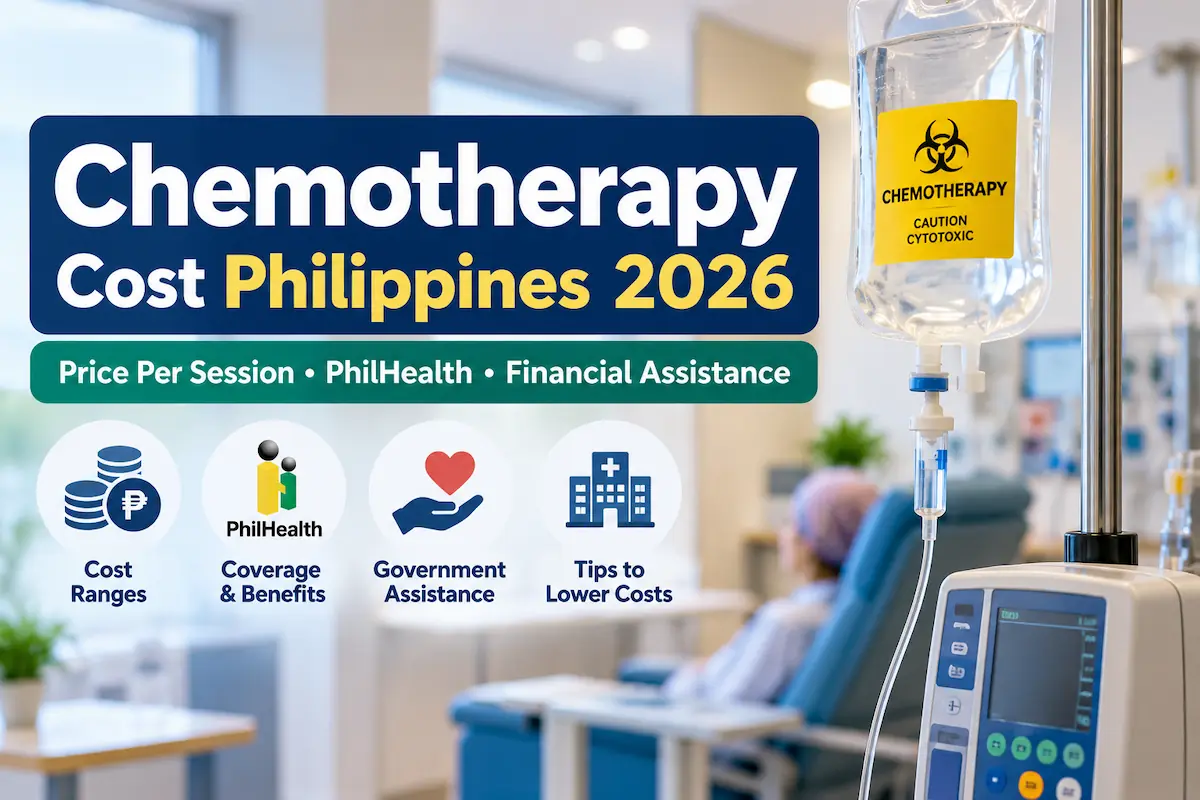
Quick answer: A widely cited Philippine estimate chemotherapy at around ₱20,000 to ₱120,000 or more per session, depending on the cancer and medicines used. However, that estimate is not a fixed hospital rate. Current hospital price lists show that the chemotherapy room or administration fee itself may be below ₱1,000, while chemotherapy drugs, oncologist fees, laboratory tests, supplies and newer targeted medicines can push the total bill much higher.
There is no single standard chemotherapy price in the Philippines. The amount a patient pays depends mainly on the exact cancer treatment regimen, the medicines prescribed, the hospital, the number of cycles and how much is covered by PhilHealth or other assistance.
That is why two patients receiving “chemotherapy” can have very different bills.
| Cost example | Published amount | What the figure means |
|---|---|---|
| Widely cited Philippine chemotherapy estimate | ₱20,000–₱120,000+ per session | Older broad budgeting estimate, not a fixed nationwide rate |
| PGH ambulatory chemotherapy | ₱500 service / ₱800 outpatient-pay | Hospital chemotherapy service fee, not the full treatment bill |
| CUMC cash outpatient chemotherapy room | ₱1,000 | Room/service charge |
| CUMC chemotherapy drug injection fee | ₱500 | Administration charge |
| BGHMC chemotherapy administration case rate | ₱7,280 per cycle | PhilHealth-related administration case-rate amount |
| Conventional breast-cancer chemotherapy drugs in a Philippine study | ₱596.70–₱3,700 per cycle | Drug-cost examples using 2021 hospital prices |
| Trastuzumab in the same study | ₱46,394.21 per cycle | Targeted-therapy drug-cost example |
The important point is that a chemotherapy administration fee is not the same as the total chemotherapy bill.
How Much Does One Chemotherapy Session Cost?
For initial budgeting, ₱20,000–₱120,000+ per session is the most commonly cited Philippine estimate. However, this number should not be treated as the official or average chemotherapy price in 2026.
Current hospital data show why a single number cannot describe every treatment. Some hospitals charge only hundreds or a few thousand pesos for the chemotherapy room or drug administration, while the medicines themselves can add thousands or tens of thousands of pesos.
The best way to budget is therefore:
Chemotherapy drugs + administration or room fee + oncologist’s professional fee + laboratory tests + supplies and supportive medicines − PhilHealth and other assistance = expected out-of-pocket bill
What Philippine Hospitals Charge for Chemotherapy
Published hospital price lists are useful because they show what the advertised “chemotherapy fee” may actually represent.
Philippine General Hospital
UP–Philippine General Hospital currently lists:
| PGH service | Service rate | Outpatient-pay rate |
|---|---|---|
| Ambulatory chemotherapy | ₱500 | ₱800 |
This does not mean a complete chemotherapy treatment at PGH costs only ₱500–₱800. PGH lists this under the Cancer Institute as its ambulatory chemotherapy service charge. The drugs and other required treatment costs depend on the patient’s treatment plan.
Capitol University Medical Center
CUMC’s published 2024 chemotherapy unit price list shows:
| Service | Published price |
|---|---|
| Chemotherapy room – cash outpatient | ₱1,000 |
| Chemotherapy room – PHIC outpatient | ₱2,000 |
| Chemotherapy drug injection fee | ₱500 |
| Port-a-cath flushing | ₱1,500 |
| Insertion fee | ₱200 |
These are service charges rather than one bundled chemotherapy price. If the prescribed drug costs ₱20,000, for example, a ₱1,000 chemotherapy-room charge does not mean the patient’s entire treatment costs ₱1,000.
Baguio General Hospital and Medical Center
BGHMC’s published Cancer Center price list gives another useful example.
It lists:
- ₱7,280 as the maximum PhilHealth case rate for chemotherapy administration per cycle;
- ₱686 as the chemotherapy supplies package included in that case rate;
- chemotherapy medicine charges separately;
- additional professional fees for private chemotherapy patients of up to ₱10,000 per cycle.
BGHMC also states that medicines exceeding the applicable case-rate amount may become an out-of-pocket expense if the patient chooses to procure them.
These examples show why you should never compare hospitals using only the words “chemotherapy fee.” Ask what the quoted amount actually includes.
Blood counts are checked before almost every cycle to make sure it is safe to proceed, so patients end up paying for repeat blood tests throughout treatment. See the CBC test price in the Philippines.
How Much Do Chemotherapy Drugs Cost?
The medicine itself is one of the biggest factors affecting the bill. A Philippine breast-cancer financing study published in 2025 reviewed costs from tertiary hospitals. They are useful, however, for showing how dramatically prices differ between medicines.
| Medicine | Cost per cycle in the study |
|---|---|
| Cyclophosphamide | ₱596.70 |
| Doxorubicin | ₱1,209.60 |
| Carboplatin | ₱2,080 |
| Docetaxel | ₱2,365–₱2,419.80 |
| Paclitaxel | ₱3,700 |
| Trastuzumab | ₱46,394.21 |
The study included seven government and two private tertiary hospitals. It also separately reported median cost of:
- ₱8,000 professional fee;
- ₱2,556.50 procedure fee;
- ₱4,600 medical supplies;
- ₱135 anti-nausea medicine;
- ₱2,810 G-CSF;
- ₱130 IV fluids.
Not every patient needs these exact items or amounts. The useful lesson is simply this: The price of the chemotherapy drug is not necessarily the price of the chemotherapy visit.
Chemotherapy vs. Targeted Therapy
These terms should not be treated as interchangeable. Conventional chemotherapy generally uses cytotoxic medicines that affect rapidly dividing cells.
Targeted therapy acts on specific molecular features involved in a cancer. Depending on the cancer, targeted therapies may be used with chemotherapy or as part of another treatment strategy. They can also be far more expensive.
In the Philippine breast-cancer costing study, trastuzumab was priced at approximately ₱46,394 per cycle, compared with hundreds to a few thousand pesos for several conventional chemotherapy drugs.
The study modeled 18 trastuzumab treatments at approximately ₱835,096 for the drug alone using its underlying historical prices.
That is one reason a chemotherapy treatment plan involving targeted medicine cannot reasonably be compared with a simple conventional chemotherapy regimen using one generic price.
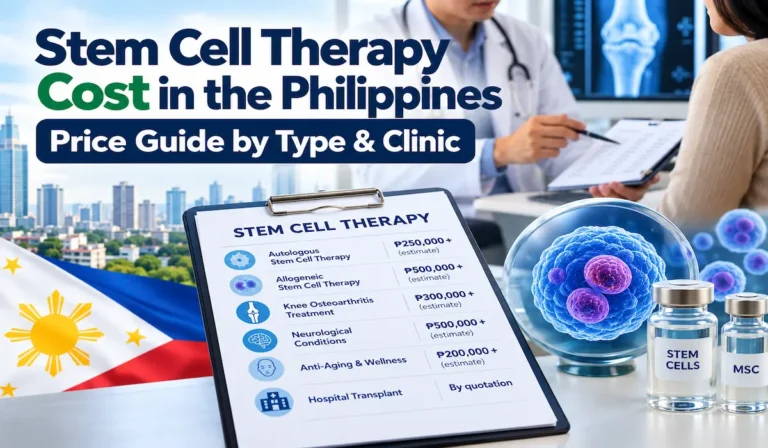
For some cancers, doctors discuss a stem cell or bone marrow transplant as part of the treatment plan after chemotherapy. If that becomes an option, the stem cell therapy cost in the Philippines gives an idea of the additional budget involved.
What Is a Chemotherapy Cycle?
Patients often search for the cost “per session,” but hospitals and oncologists may price or describe treatment by cycle. A chemotherapy cycle is a period of treatment followed by a recovery or rest period. Depending on the regimen, one cycle may involve:
- one infusion;
- several treatment days;
- weekly treatments;
- treatment followed by one or more weeks without chemotherapy.
This makes an important difference when comparing prices. For example, ₱25,000 per session and ₱25,000 per cycle may mean very different total costs if one cycle contains multiple treatment visits.
Before accepting a quotation, ask “Is this price for one infusion, one treatment day, or the entire cycle?”
What Can Be Added to Your Chemotherapy Bill?
A treatment quotation may include only some of the following:
| Possible charge | Why it may appear |
|---|---|
| Chemotherapy medicines | Depends on the exact regimen and dose |
| Chemotherapy room / administration | Facility charge for giving treatment |
| Medical oncologist’s professional fee | May be billed separately |
| IV and medical supplies | Depends on hospital and regimen |
| Anti-nausea medicines | Frequently used with some regimens |
| Other supportive medicines | Depends on the patient’s treatment |
| Laboratory tests | Often required before or during treatment |
| G-CSF | Used for selected patients/regimens |
| IV fluids | Depends on treatment |
| Port-a-cath services | Applicable to some patients |
| Hospital admission | If treatment or complications require inpatient care |
| Imaging | May be needed to stage or monitor the cancer |
This is why the best hospital estimate is an itemized quotation, not simply a headline “chemo price.”
What Affects the Cost of Chemotherapy?
Cancer Type and Treatment Plan
Different cancers use different medicines and combinations. Even two patients with the same cancer can receive different treatments depending on factors such as stage, tumor characteristics and the treatment recommended by their oncology team.
Drug Regimen
Some treatments use one chemotherapy medicine. Others combine two or more. Adding targeted therapy or another expensive medicine can change the total dramatically.
Dose
Chemotherapy doses may be based on factors such as body size and the treatment protocol. The required number of vials can therefore affect medicine cost.
Number of Cycles
A relatively affordable individual cycle can still create a large total expense if treatment continues over many cycles.
Hospital and Professional Fees
Hospitals charge differently for infusion facilities, supplies and professional services.
Tests and Supportive Medicines
Cancer treatment often involves more than the chemotherapy drug itself. Laboratory monitoring and medicines used to prevent or manage treatment effects can add to the bill.
Public vs. Private Hospital Costs
There is no reliable nationwide table showing one public-hospital chemotherapy price and one private-hospital chemotherapy price.
Government facilities can have subsidized service charges and are important access points for government cancer programs. However, the actual bill still depends heavily on medicine availability and the treatment regimen.
Older Philippine cancer-cost data cited in PIDS-hosted reporting found that patients shouldered about 29% of direct outpatient cancer costs in public hospitals compared with 64% in private hospitals.
Those figures describe overall outpatient cancer spending—not the price of one chemotherapy session—and they should not be treated as a current hospital quotation.
If affordability is a major concern, compare written estimates for the same chemotherapy regimen, then ask each facility what PhilHealth and government assistance can be applied.
How Much Can a Full Course of Chemotherapy Cost?
There is no useful universal answer because a full course can contain several cycles and very different medicines.
If someone paid ₱20,000 per treatment for six treatments, that would be ₱120,000 before considering other expenses. A patient receiving more expensive medicines could spend much more.
For cancer care overall, older Philippine estimates have placed treatment expenses from around ₱120,000 to more than ₱1 million. Some treatment plans involving surgery, targeted therapy, radiation and prolonged medication can exceed that.
Do not multiply a generic online “chemo price” by the number of sessions and assume that will be your final bill. Ask your oncology team for the planned regimen and expected number of cycles, then request an estimate from the hospital.
Does PhilHealth Cover Chemotherapy?
PhilHealth can provide substantial cancer-treatment benefits, but the amount depends on the cancer, treatment and applicable benefit package. PhilHealth’s current Z Benefits page lists cancer packages for:
- acute lymphocytic/lymphoblastic leukemia;
- breast cancer;
- prostate cancer;
- cervical cancer;
- colon cancer;
- rectal cancer.
Current published package amounts include:
| Cancer | PhilHealth Z Benefit |
|---|---|
| Acute lymphocytic/lymphoblastic leukemia, standard risk | ₱500,000 |
| Breast cancer, clinical Stage 0–IV | Up to ₱1.4 million |
| Prostate cancer, qualifying low/intermediate risk | ₱100,000 |
| Cervical cancer – cobalt + low-dose brachytherapy | ₱120,000 |
| Cervical cancer – linear accelerator + high-dose brachytherapy | ₱175,000 |
| Colon cancer Stage I–II low risk | ₱150,000 |
| Colon cancer Stage II–III high risk | ₱300,000 |
| Rectal cancer Stage I–II low risk | ₱150,000 |
| Qualifying higher-risk rectal cancer treatment | Up to ₱400,000 |
These figures are PhilHealth benefit-package amounts, not the hospital’s cash price. Patients have to meet the applicable eligibility and treatment criteria.
The treatment must also be obtained through an appropriate PhilHealth-contracted provider for the Z Benefit. PhilHealth’s cancer-contracted-facility list was updated as of August 31, 2026.
PhilHealth Breast Cancer Chemotherapy Coverage
Breast cancer currently has one of PhilHealth’s most comprehensive cancer packages. The enhanced Z Benefit covers clinical Stage 0 through Stage IV, subject to package requirements. PhilHealth’s official schedule assigns different amounts to different chemotherapy protocols.
Examples include:
| Breast cancer treatment | PhilHealth rate |
|---|---|
| Doxorubicin/epirubicin + cyclophosphamide (AC) | ₱10,980 per cycle |
| Paclitaxel phase | ₱12,840 per cycle |
| Docetaxel phase | ₱16,750 per cycle |
| Docetaxel + carboplatin | ₱30,835 per cycle |
Depending on the protocol, the total cytotoxic chemotherapy component can reach approximately ₱185,010. The overall breast-cancer Z Benefit can reach ₱1.4 million, with a large part of the expanded benefit intended for eligible targeted therapy.
These are PhilHealth benefit rates not a statement that the medicine or hospital normally charges exactly that amount. If breast-cancer treatment is being planned, contact the facility’s Z Benefits Coordinator before treatment whenever possible so eligibility and authorization can be checked.
Can You Get Free or Subsidized Cancer Medicines?
Possibly. The Department of Health operates programs intended to reduce cancer patients’ out-of-pocket expenses.
Cancer and Supportive-Palliative Medicines Access Program
The Cancer and Supportive-Palliative Medicines Access Program (CSPMAP) provides cancer and supportive medicines to eligible patients through participating government access sites. DOH information describes priority cancer groups that include cancers such as:
- breast cancer;
- childhood cancers;
- gynecologic cancers;
- liver cancer;
- blood cancers;
- head and neck cancers;
- lung cancer;
- prostate cancer;
- renal cancer;
- urinary bladder cancer.
Medicine availability and eligibility depend on the program and access site. The program remains active in 2026. DOH hospitals, including East Avenue Medical Center, have continued procuring medicines specifically under CSPMAP during 2026.
Before buying expensive chemotherapy medicines privately, ask your hospital “Is this medicine available through CSPMAP, and am I eligible?”
Cancer Assistance Fund: Up to ₱150,000 in Support
The Cancer Assistance Fund (CAF) was established under the National Integrated Cancer Control Act to support cancer medicine and treatment assistance.
Current DOH Bicol information states that eligible cancer patients may receive ₱150,000 through CAF for cancer-care needs such as diagnostic and treatment services. The same current DOH information reports 34 CAF/CSPMAP access sites nationwide.
CAF assistance is not the same as receiving ₱150,000 cash in hand. The support is accessed through participating cancer facilities and is subject to the program’s requirements, treatment needs and implementation rules.
One current government hospital CAF checklist, for example, asks for documents such as:
- patient identification;
- physician’s request or prescription;
- charge slips;
- updated clinical abstract or medical certificate.
Ask the medical social service, cancer center or patient navigation office at the hospital where you are being treated.
DSWD AICS Assistance for Chemotherapy
The Department of Social Welfare and Development’s Assistance to Individuals in Crisis Situations (AICS) program can provide medical assistance for patients in financial difficulty.
DSWD’s official guidance specifically lists chemotherapy among special treatments for which medical assistance may be requested. The amount is not a fixed chemotherapy allowance. It depends on the patient’s need and the social worker’s assessment.
DSWD reported in February 2026 that more than 23,000 cancer patients received over ₱200 million in medical assistance during 2025. AICS remains active in 2026 and has also been expanding the use of guarantee letters for medical assistance.
If you need help, ask what current documents are required before traveling to an AICS office or processing center.
PCSO Assistance for Chemotherapy Drugs
The Philippine Charity Sweepstakes Office’s Medical Access Program (MAP) also accepts requests involving cancer treatment. Its official application form specifically lists chemotherapy drugs.
For chemotherapy assistance, PCSO documentation may require items such as:
- oncologist’s prescription;
- treatment protocol;
- clinical or medical abstract;
- quotations from qualified suppliers;
- valid identification;
- MAP application documents.
Requirements can change, so check the current PCSO instructions before applying. Your hospital medical social service may also help explain the process.
Malasakit Centers
If you are being treated in a government hospital with a Malasakit Center, ask there about available assistance. Malasakit Centers are intended to make it easier for eligible patients to access participating government medical-assistance programs in one location.
Cancer treatment often involves several possible sources of help, so the hospital’s medical social worker is one of the most useful people to speak with early in treatment.
What About HMO or Private Health Insurance?
Cancer coverage varies widely between plans. Before chemotherapy begins, ask specifically whether your plan covers:
- chemotherapy administration;
- chemotherapy drugs;
- targeted therapy;
- immunotherapy;
- oncologist professional fees;
- laboratory tests;
- hospitalization;
- outpatient infusion treatment.
Also ask about:
- annual benefit limits;
- cancer-specific limits;
- pre-authorization;
- Letter of Authorization requirements;
- accredited hospitals and oncologists.
Approval for the chemotherapy room does not automatically mean an expensive chemotherapy drug is also covered. Get the coverage details in writing when possible.
Because chemotherapy is given in cycles, coverage matters a lot to the total bill. Comparing plans in our guide to the best HMO in the Philippines can help you see how much of each session may be shouldered by insurance.
Senior Citizen and PWD Discounts
Eligible senior citizens and PWDs have statutory healthcare benefits in the Philippines.
Senior Citizens
RA 9994 provides a 20% discount and VAT exemption, where applicable, on qualifying medicines and medically necessary services in private facilities, including physician-requested diagnostic and laboratory services and professional fees.
If a service is already being offered under a promotion, the senior citizen may use the promotional discount or statutory discount, whichever is higher.
Persons With Disability
PWD rules likewise provide at least a 20% discount and VAT exemption on qualifying medicines, medical services, diagnostic services and professional fees.
The PWD rules also prohibit simply stacking the statutory discount on top of another promotional discount; the more favorable applicable discount is used. Cancer billing can be more complicated when PhilHealth and other government assistance are also involved.
For that reason, ask the billing department to calculate the final amount instead of subtracting 20% from the original chemotherapy quotation yourself.
How to Reduce Your Chemotherapy Costs
Ask for an Itemized Treatment Estimate
Get the name of the exact regimen, expected number of cycles and estimated cost of:
- chemotherapy drugs;
- administration;
- oncologist’s fee;
- laboratory monitoring;
- supplies;
- supportive medicines.
This makes it much easier to identify which part of the bill needs financial assistance.
Check PhilHealth Before the First Cycle
If your cancer qualifies for a Z Benefit, eligibility and authorization should be checked early. Ask whether the hospital is a contracted provider for your specific cancer package.
Ask About CAF and CSPMAP Before Buying Medicines
If the medicine is available through a government program, buying it privately first could create an avoidable out-of-pocket expense. Ask the oncology center or hospital social service what is currently available.
Ask About Lower-Cost Medicine Options
For some medicines, different brands, generic products or biosimilars may exist. Do not substitute a cancer medicine yourself. Instead, ask the oncologist whether there is a lower-cost medically appropriate option for the prescribed treatment.
Apply for DSWD or PCSO Assistance Early
These programs require documents and assessment. It is usually easier to prepare them before a large bill becomes due rather than after treatment has already been paid in full.
Compare the Same Regimen
If you compare hospitals, provide both hospitals with the same oncologist’s treatment protocol. A ₱15,000 quote that excludes medicines cannot fairly be compared with a ₱40,000 quote that includes them.
Before Your First Chemotherapy, Ask These Questions
Before paying, take the treatment plan to the billing or cancer-center office and ask:
- What is the exact name of my chemotherapy regimen?
- How much are the chemotherapy medicines for one cycle?
- Is this quote per session or per complete cycle?
- How many cycles are currently planned?
- Is the oncologist’s professional fee included?
- Is the chemotherapy room or administration fee included?
- Are laboratory tests, medical supplies and supportive medicines included?
- How much will PhilHealth cover?
- Does my cancer qualify for a Z Benefit?
- Can CAF or CSPMAP cover any part of this treatment?
- Can DSWD, PCSO or Malasakit assistance help with the remaining bill?
- What amount should I expect to pay myself for the next cycle?
Those questions give you a much more useful answer than simply asking, “Magkano ang chemo?”
Frequently Asked Questions
Magkano ang chemotherapy sa Pilipinas?
The most commonly cited Philippine estimate is approximately ₱20,000 to ₱120,000 or more per session, depending on the cancer and treatment.
However, this is an older broad estimate—not an official 2026 nationwide rate. Your actual bill depends primarily on your exact drugs, hospital fees and available coverage.
How much is chemotherapy at PGH?
PGH currently publishes an ambulatory chemotherapy service rate of ₱500 and an outpatient-pay rate of ₱800. This is a hospital service charge and should not be interpreted as the complete chemotherapy bill.
The prescribed medicines and other treatment costs are separate or depend on the patient’s treatment plan.
How much does chemotherapy cost per cycle?
There is no single price. The cycle cost depends on the drugs and how many treatment visits are included.
Published hospital data show administration charges ranging from hundreds to several thousand pesos, while medicines can range from relatively inexpensive conventional drugs to targeted treatments costing tens of thousands of pesos per cycle.
Is chemotherapy free in a government hospital?
Not automatically. Government hospitals may have subsidized fees, and eligible patients may receive assistance through PhilHealth, CAF, CSPMAP, DSWD, PCSO or other programs.
These programs can substantially reduce out-of-pocket expenses, but eligibility and medicine availability matter.
Does PhilHealth cover chemotherapy?
Yes, chemotherapy and other cancer treatment can be covered under applicable PhilHealth benefits.
PhilHealth currently has Z Benefit cancer packages for acute lymphocytic/lymphoblastic leukemia, breast cancer, prostate cancer, cervical cancer, colon cancer and rectal cancer.
The exact benefit depends on the cancer, stage, eligibility criteria and treatment.
How much does PhilHealth cover for breast cancer?
The current PhilHealth Z Benefit for breast cancer covers clinical Stage 0 through IV and can reach up to ₱1.4 million, depending on the required services. Different chemotherapy protocols have their own benefit rates.
Can I receive ₱150,000 from the Cancer Assistance Fund?
Current DOH information describes CAF support of ₱150,000 for eligible cancer patients. It should not be understood as an automatic cash payment to every person diagnosed with cancer. The assistance is accessed through participating cancer facilities and is subject to program requirements.
Are chemotherapy and targeted therapy the same?
No. They are different types of cancer treatment, although they may sometimes be used together. Targeted therapies can also be considerably more expensive than some conventional chemotherapy medicines.
How many chemotherapy sessions will I need?
There is no standard number. The oncology team determines the regimen and cycle schedule based on the cancer and treatment plan. Ask for the expected number of cycles when requesting a cost estimate.
What You Should Budget
For a person who is only beginning to plan, ₱20,000–₱120,000+ per chemotherapy session can be used as a broad reference because it is the most frequently cited Philippine range.
But it should not be treated as a current national average. Current hospital schedules show why.
A hospital may list only ₱500–₱1,000 for the chemotherapy service or room, while the medicines, professional fees and other treatment components can increase the actual bill substantially.
The most reliable budget is the price of your exact treatment plan. Before your first cycle, ask for this calculation: Chemotherapy medicines + administration fee + oncologist fee + laboratory tests + medical supplies/supportive medicines − PhilHealth − CAF/CSPMAP − other approved assistance = expected patient payment.
If cost is a major concern, speak with the hospital’s oncology unit, PhilHealth/Z Benefits coordinator and medical social service office before purchasing expensive medicines privately. They can tell you which current benefits or assistance programs may apply to your treatment.
How CareCostPH Checked These Costs
CareCostPH reviewed publicly available information from Philippine hospitals, PhilHealth, Department of Health cancer programs, government assistance agencies and Philippine cancer-cost research.
The most commonly quoted ₱20,000–₱120,000+ per-session range comes from older Philippine reporting and should be used only as a broad planning reference.
For current context, we also checked actual published hospital charges from facilities including UP–Philippine General Hospital and Baguio General Hospital and Medical Center.
We kept the following amounts separate:
- chemotherapy administration fees;
- chemotherapy medicine costs;
- targeted-therapy costs;
- professional fees;
- hospital charges;
- PhilHealth benefit amounts;
- government financial assistance.
This matters because combining them into one price range can make chemotherapy look either much cheaper or much more expensive than the patient’s actual treatment.
For more about our research process, see CareCostPH’s How We Research Prices page.
Medical and pricing note: Cancer-treatment prices, medicine availability and government benefits can change. Confirm the current treatment estimate and coverage with your hospital and oncology team. This guide provides general cost information and does not replace individualized medical advice.

One Comment