Stem Cell Therapy Cost in the Philippines 2026: Prices, Clinics & Safety
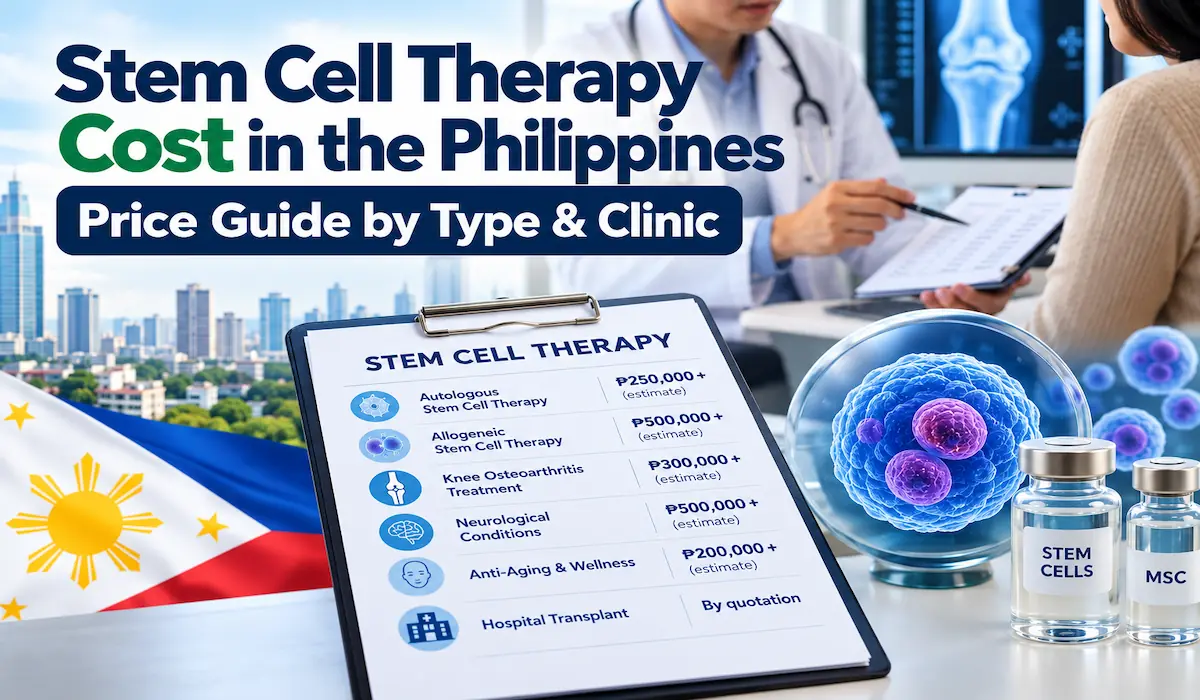
Quick answer: Stem cell therapy in the Philippines can cost hundreds of thousands of pesos, depending on the cell source, treatment and facility. Among publicly advertised offers reviewed by CareCostPH, APEX International Wellness Clinic lists stem cell-containing wellness packages at ₱429,999 and ₱1,300,000. A separate medical-travel price guide estimates ₱250,000–₱5,000,000 across different types of stem cell treatment, but these are third-party estimates. Hospital-based stem cell transplantation requires a separate quotation.
When it is used: Stem cell treatments are used in established medical care for certain blood cancers, blood disorders and immune-system conditions, particularly through hematopoietic stem cell transplantation. Other cell-based interventions are being investigated for knee osteoarthritis, tissue injuries and neurological diseases. Private clinics also market stem cell procedures for anti-aging, skin rejuvenation and general wellness.
Stem Cell Therapy Price in the Philippines by Type
The term stem cell therapy covers several different procedures. A treatment using a patient’s own cells is not the same as one using donated cells, and neither should automatically be compared with a hospital stem cell transplant.
| Stem Cell Therapy Type | Available Price Information | Important Notes |
|---|---|---|
| Autologous stem cell therapy (own cells) | ₱250,000–₱1,000,000 | Third-party guide estimate, not verified clinic rate |
| Allogeneic stem cell therapy (donor cells) | ₱500,000–₱2,000,000 | Third-party guide estimate; varies by treatment |
| Umbilical cord MSC wellness package | ₱429,999 | Actual advertised multi-service clinic package |
| Human bone marrow MSC wellness package | ₱1,300,000 | Actual advertised multi-service clinic package |
| Stem cell injection for knee arthritis | Individual quotation required | No reliable comparable Philippine per-injection price verified |
| Stem cell treatment for neurological conditions | Individual quotation required | Investigational uses require particular caution |
| Hospital stem cell or bone marrow transplant | Hospital quotation required | Different procedure, often requiring admission |
How to read the table: The autologous and allogeneic ranges come from a published medical-travel guide, not a survey of Philippine hospital price lists. The two specific wellness-package prices are advertised by APEX International Wellness Clinic. These amounts should not be combined to calculate an average Philippine stem cell therapy price.
The exact cost depends on the proposed treatment, how cells are collected and processed, the number of sessions and whether the clinic includes medical evaluation and follow-up.
Actual Stem Cell Therapy Package Prices at a Philippine Clinic
APEX International Wellness Clinic provides publicly accessible package and consultation prices.
| Advertised Service | Published Price | Main Inclusions |
|---|---|---|
| Platinum BioRenewal Protocol | ₱429,999 | Umbilical cord mesenchymal stem cell therapy, exosomes, EBOO therapy and additional wellness services |
| Cellular Rebirth Protocol | ₱1,300,000 | Human bone marrow mesenchymal stem cell therapy, exosomes and additional wellness services |
| Stem Cell Consultation (45 minutes) | ₱2,500 | Regenerative medicine assessment |
| General In-Person Consultation (30 minutes) | ₱800 | Physician consultation |
| Online Consultation (30 minutes) | ₱1,000 | Video consultation |
What do these packages include?
The ₱429,999 Platinum BioRenewal Protocol advertises umbilical cord mesenchymal stem cell therapy alongside exosomes, EBOO therapy, hyperbaric oxygen, colon cleansing, IV vitamins and consultation.
The ₱1,300,000 Cellular Rebirth Protocol advertises human bone marrow mesenchymal stem cell therapy alongside exosomes and complimentary wellness services.
These are bundled commercial prices. They do not establish the cost of stem cells alone, the efficacy of the bundled treatments or approval for a particular medical condition.
Patients should request an itemized breakdown before paying. Clinic advertising and promotional descriptions are not independent clinical evidence.
Autologous vs Allogeneic Stem Cell Therapy
One of the most important decisions is understanding where the cells come from.
| Factor | Autologous | Allogeneic |
|---|---|---|
| Cell source | Patient’s own cells | Donor cells |
| Collection | May require bone marrow, blood or fat collection | Donor collection occurs separately |
| Processing | Depends on procedure | Depends on product and processing method |
| Compatibility | No separate donor required | Donor screening and compatibility considerations may apply |
| Cost drivers | Collection, processing, administration, medical team | Donor sourcing, testing, processing, storage, administration |
| Common medical context | Certain transplants and investigational regenerative procedures | Certain transplants and investigational donor-cell treatments |
Autologous stem cell therapy
Autologous procedures use cells collected from the patient’s own body. Depending on the treatment, cells may come from:
- Bone marrow
- Peripheral blood
- Adipose or fat tissue
Bone marrow aspirate concentrate (BMAC) and adipose-derived preparations are frequently discussed in regenerative medicine. However, not every concentrated tissue preparation is equivalent to a purified or culture-expanded stem cell product.
Allogeneic stem cell therapy
Allogeneic procedures use cells obtained from another person. Donor-derived products may involve umbilical cord blood, bone marrow or other cellular sources.
In medically established transplantation, donor compatibility and infection screening are especially important. Other commercial donor-cell interventions have different requirements and must be evaluated under the applicable Philippine regulatory framework.
Important: Whether a treatment is permitted or approved cannot be determined from the words autologous, allogeneic or minimally manipulated alone.
Stem Cell Therapy Cost by Medical Condition
Different medical conditions may require entirely different evaluations, procedures and specialists.
Stem Cell Therapy for Knee Osteoarthritis
People with knee osteoarthritis sometimes consider stem cell injections when pain and stiffness continue despite other treatments. Some clinics market injections involving bone marrow concentrates, adipose-derived cell preparations or mesenchymal stromal cells.
A medical-travel guide estimates ₱300,000–₱700,000 for orthopedic regenerative treatments, but this is not a verified Philippine price range for one knee injection. An actual quotation should specify whether the price is per knee, per session or for a complete course.
Possible additional expenses include imaging, specialist consultation, injection guidance and rehabilitation.
Does it work? The International Society for Stem Cell Research (ISSCR) describes cell-based therapy for osteoarthritis as unproven. Some studies report pain relief, but more rigorous trials have not consistently shown advantages over standard treatments, and significant cartilage regeneration has not been demonstrated.
Patients should discuss the evidence and established alternatives with an independent orthopedic specialist.
Stem Cell Therapy for Spine and Disc Problems
Stem cell-based procedures are sometimes advertised for degenerative disc disease, back pain and spinal conditions. These interventions may require image-guided injections or other specialized administration methods.
No sufficiently reliable Philippine price was verified for a comparable spine stem cell procedure. Additional charges may include MRI, anesthesia, specialist fees, procedure-room charges and follow-up care.
Evidence for these applications remains limited, and the specific proposed intervention should be assessed separately.
Stem Cell Therapy for Stroke and Neurological Conditions
Commercial clinics may advertise stem cell interventions for stroke, Parkinson’s disease, multiple sclerosis, spinal cord injuries and other neurological conditions.
A third-party price guide estimates ₱500,000–₱1,200,000 for neurological regenerative treatments, but this is not a confirmed provider quotation.
These conditions should not be treated as having one standard stem cell protocol or one established price. Many such interventions are still being studied. Patients should be especially cautious about promises of nerve regeneration, restored movement or guaranteed functional recovery.
Stem Cell Therapy for Anti-Aging and Skin Rejuvenation
Some wellness and aesthetic clinics advertise treatments involving stem cells, exosomes or other regenerative products.
A medical-travel guide estimates ₱200,000–₱600,000 for cosmetic and anti-aging regenerative interventions. However, that figure is not based on a verified comparison of equivalent Philippine procedures.
The ₱429,999 APEX wellness package provides a specific example of a published multi-service offer. Claims that commercial stem cell treatments reverse aging, restore youth or prevent chronic disease require convincing clinical evidence. Such benefits should not be assumed.
Stem Cell Therapy for Blood Cancer and Blood Disorders
Hematopoietic stem cell transplantation (HSCT) is a different category from cosmetic or elective regenerative injections. It is used in selected cases of leukemia, lymphoma, multiple myeloma and other serious blood or immune disorders.
A transplant may involve chemotherapy, donor matching, stem cell collection, hospitalization, medicines and prolonged monitoring. For this reason, patients should obtain a detailed estimate from the hospital’s transplant or hematology service rather than using prices advertised by wellness clinics.
Some stem cell procedures are discussed alongside standard cancer treatment. You can check the chemotherapy cost in the Philippines for the conventional treatment budget.
What Makes Stem Cell Therapy Expensive?
A quotation may include much more than the stem cell product itself.
| Cost Factor | Why It Matters |
|---|---|
| Cell source | Obtaining cells from bone marrow, blood, fat or a donor involves different procedures |
| Cell processing | Preparation, screening, quality testing and storage may add expenses |
| Treatment complexity | Simple administration differs from specialized image-guided or hospital procedures |
| Number of sessions | Multiple treatments can increase the total cost |
| Specialist fees | Physicians and other healthcare professionals may bill separately |
| Facility charges | Hospital or procedure-room use may be added |
| Follow-up monitoring | Additional tests, medicines or visits may be required |
| Combination treatments | Exosomes, PRP or other services may be bundled into the package |
Higher cell counts, larger packages or more sessions do not automatically mean better outcomes.
The medically relevant question is whether a specific product and treatment protocol have reliable evidence for the patient’s condition.
What Is Included in the Stem Cell Therapy Package?
There is no universal package structure. Some providers advertise a combined treatment price, while others quote each service separately. Before booking, request written confirmation of:
- Consultation and specialist assessment
- Cell collection or donor-cell procurement
- Cell preparation, processing and quality testing
- Number of injections or infusions
- Procedure-room and professional fees
- Imaging or laboratory examinations
- Anesthesia, if required
- Medication and observation
- Follow-up consultations
- Additional or repeat treatments
Possible Additional Charges
| Additional Expense | When It May Be Needed |
|---|---|
| MRI or other imaging | Evaluation or procedure planning |
| Blood tests | Baseline screening and medical clearance |
| Anesthesia | Certain collection or administration procedures |
| Procedure-room fees | Specialized treatments |
| Hospital admission | Complicated procedures or transplantation |
| Rehabilitation | Orthopedic or neurological recovery care |
| Follow-up imaging | Monitoring after treatment |
| Medications | Depending on the procedure |
| Cell storage | If cells are collected for future use |
No standardized Philippine add-on rates were verified for these stem cell packages. Patients should request the actual fees applicable to their proposed procedure rather than budgeting from unrelated price estimates.
Is Stem Cell Therapy FDA-Approved in the Philippines?
The Philippines has a regulatory framework for human stem cell and cell-based therapies. DOH Administrative Order No. 2013-0012 establishes requirements for the accreditation of facilities performing these treatments and identifies prohibited, restricted and permitted categories of cell preparations.
The order makes an important distinction between regulatory authorization and clinical effectiveness.
Treatments prohibited under the 2013 DOH order
The order identifies prohibited categories including:
- Creation of human embryos for research purposes
- Human embryonic stem cells and derivatives for human treatment and research
- Aborted human fetal stem cells and derivatives for human treatment and research
- Plant parts marketed as stem cells
Treatments requiring special regulatory approval
The order also identifies restricted categories, including genetically altered stem cells and adipose-derived human stem cells. This means a clinic should not claim that every procedure involving a patient’s own fat or same-day cell preparation is automatically authorized.
How to check a stem cell clinic
Ask the provider for the relevant documentation and independently confirm its validity.
- DOH facility accreditation: Ask whether the facility has the authorization required for the exact stem cell activity.
- FDA product authorization: Ask which requirements apply to the specific cells or product being administered.
- Physician credentials: Confirm the professional’s license and relevant specialty.
- Clinical evidence: Request published studies supporting the specific treatment for the condition being addressed.
- Product traceability: Ask how the cells are sourced, screened, processed, stored and tested.
A general clinic license or product registration for an unrelated service does not establish that a specific stem cell intervention is authorized.
Is Stem Cell Therapy Safe?
The safety of stem cell treatment depends heavily on the exact procedure. Established hematopoietic stem cell transplantation has recognized medical uses, but also involves potentially serious complications and requires specialized care.
Unproven regenerative interventions can carry risks without established benefits. Potential complications include infection, immune reactions, tissue damage and problems related to improper cell processing or administration.
Patients should also ask how complications are managed and whether an appropriate hospital referral or emergency-care arrangement exists.
Warning Signs of an Unreliable Stem Cell Provider
Be cautious when a clinic:
- Promises a guaranteed cure
- Claims the same treatment works for many unrelated diseases
- Refuses to identify the cells or their source
- Cannot provide applicable regulatory documentation
- Says no medical assessment is needed
- Uses testimonials instead of credible clinical evidence
- Pressures patients to pay large non-refundable deposits immediately
- Cannot explain risks or complication management
- Guarantees permanent regeneration after one session
A high treatment price is not proof of safety, authorization or effectiveness.
Does PhilHealth Cover Stem Cell Therapy?
PhilHealth issued a public clarification in August 2013 stating that it was not paying for stem cell therapy at that time. No current standalone PhilHealth benefit specifically reimbursing elective stem cell wellness, anti-aging or osteoarthritis injections was established from the official information reviewed.
For patients requiring hospital-based hematopoietic stem cell transplantation, the situation must be assessed separately. PhilHealth offers benefits for some serious diseases, including qualifying cancers, but a disease-specific benefit should not be interpreted as automatic coverage for every associated procedure.
Ask the hospital’s PhilHealth office:
- Is my diagnosis eligible for an existing benefit?
- Does that benefit specifically cover the proposed procedure?
- Is this hospital contracted for the relevant package?
- Which expenses are excluded?
- How much would I personally need to pay?
Do not assume that a Z Benefit for a cancer diagnosis is a dedicated stem cell transplant benefit.
Official reference: PhilHealth Benefits
Does HMO Cover Stem Cell Therapy?
HMO coverage depends on the member’s contract and the medical necessity of the proposed procedure. Experimental, investigational, cosmetic and elective wellness treatments may be excluded.
For any proposed stem cell procedure, contact the HMO before paying and request written confirmation of coverage. Ask whether the facility is accredited, whether a letter of authorization is required and whether separate professional or hospital fees are covered.
Can You Get Government Financial Assistance?
Patients facing the cost of medically necessary hospital treatment may ask about assistance from:
- Malasakit Centers
- Philippine Charity Sweepstakes Office (PCSO)
- Department of Social Welfare and Development (DSWD)
- Local government medical assistance programs
Eligibility depends on the patient’s circumstances, the treatment and the applicable program. These programs should not be assumed to finance elective wellness or experimental stem cell packages.
For medically indicated hospitalization or transplantation, the hospital social service office can help explain available assistance and documentation requirements.
Senior Citizen and PWD Discounts
Under Republic Act No. 9994, eligible senior citizens receive a 20% discount and applicable VAT exemption on covered medical services and professional fees.
Republic Act No. 10754 provides corresponding medical-service benefits for eligible persons with disabilities.
Whether particular components of a stem cell package qualify depends on the nature of the service and applicable billing rules.
Request an itemized quotation identifying professional fees, facility charges, products and other services, then ask the provider to show how the applicable discount and VAT exemption have been calculated.
Do not assume that every part of an elective wellness package qualifies for the same discount.
How to Choose a Stem Cell Clinic in the Philippines
When comparing clinics in Metro Manila, Cebu, Davao or other locations, focus on treatment appropriateness and verification before price. A clinic’s location, advertising or association with a major medical brand does not establish the regulatory status of a particular treatment.
Questions to Ask Before Paying
About the medical treatment
- What is my exact diagnosis?
- Why is this particular stem cell procedure being recommended?
- Is it established treatment or experimental?
- What published evidence supports its use for my condition?
- What standard treatments are available instead?
About the cells and facility
- Are the cells autologous or donor-derived?
- Where are they collected and processed?
- What screening and quality tests are performed?
- Does the facility hold the necessary DOH authorization?
- What FDA requirements apply to this product?
- Who is responsible for managing complications?
About the price
- Is the quotation for one session or an entire treatment course?
- Are cell collection and laboratory processing included?
- Will I pay extra for imaging, anesthesia or admission?
- Are rehabilitation and follow-up included?
- What happens if I am medically ineligible?
- What is the cancellation and refund policy?
About outcomes
- What improvement is realistically expected?
- How will success or failure be assessed?
- What happens if the treatment does not work?
- Are there long-term follow-up requirements?
A qualified independent specialist can help evaluate whether the proposed treatment is reasonable for the patient’s actual diagnosis.
Frequently Asked Questions
How much is one stem cell injection in the Philippines?
There is no verified standard Philippine price for one stem cell injection. Advertised packages may include multiple services and should not be divided into arbitrary per-injection costs. Request a quotation for the exact cell preparation and treatment session.
What is the cheapest stem cell therapy in the Philippines?
The lowest broadly advertised estimate found in a third-party price guide starts at ₱200,000–₱250,000 for certain categories, but this is not a confirmed clinic quotation. Some services marketed using the term “stem cell” cost less but may not involve transplantation or administration of living stem cells.
Is PRP the same as stem cell therapy?
No. Platelet-rich plasma (PRP) uses concentrated platelets obtained from the patient’s blood. It is different from administering a stem cell preparation. Some clinics combine the two or market them together, but they should be evaluated separately for cost, evidence and safety.
Can stem cell therapy cure knee arthritis?
There is no convincing evidence that commercially marketed stem cell injections cure knee osteoarthritis or reliably regrow damaged cartilage. Some studies report symptom improvement, but results vary and more rigorous studies have shown important limitations.
Does stem cell therapy work for stroke?
Stem cell-based approaches for stroke recovery remain an area of research. No commercially advertised intervention should be presumed to restore brain function or reverse stroke-related disability. Patients should consult their neurologist and rehabilitation team about evidence-based care.
How many sessions of stem cell therapy are needed?
There is no universal number. Hospital transplantation follows a specific medical protocol, while commercial regenerative programs may advertise one or multiple sessions. More sessions do not automatically establish greater effectiveness.
How long do stem cell therapy results last?
There is no reliable universal duration. Outcomes depend on the condition and type of treatment. Patients should be cautious of clinics promising permanent results or recommending annual boosters without convincing supporting evidence.
Is stem cell therapy legal in the Philippines?
Some stem cell and cell-based procedures may be legally performed under applicable Philippine rules, while other preparations are restricted or prohibited. The facility, product, procedure and indication must be evaluated individually.
Is stem cell therapy worth the cost?
For an established medically indicated procedure, the potential benefits and risks should be discussed with the specialist overseeing treatment. For experimental or unproven interventions, a high price does not guarantee benefit. Independent clinical advice and transparent regulatory documentation are especially important before committing large sums of money.
Before You Book: What You May Actually Pay
The publicly advertised stem cell-containing wellness packages reviewed for this article cost ₱429,999 and ₱1,300,000. These are package prices, not standardized treatment fees.
Broader market estimates extend from around ₱250,000 to several million pesos, but they combine different procedures and cannot reliably predict an individual’s bill.
Before making a payment, obtain:
- A written diagnosis and treatment explanation.
- Evidence supporting the proposed procedure.
- Applicable DOH and FDA authorization details.
- A complete itemized quotation.
- Written information about risks, follow-up and refunds.
The most important comparison is not simply which clinic charges less. It is whether the proposed treatment is appropriate, supported by evidence, properly authorized and transparently priced.
How CareCostPH Checked These Prices
CareCostPH reviewed publicly accessible Philippine clinic pricing, third-party treatment estimates, DOH regulatory documentation, PhilHealth information and international guidance on stem cell treatments on October 19, 2026.
Clinic package prices are distinguished from third-party estimates. Prices attributed to individual hospitals without a verifiable public rate card have not been included.
Medical disclaimer: This article provides general price and treatment information, not individualized medical advice. Confirm costs and regulatory status directly with the provider. Consult a qualified healthcare professional before considering stem cell treatment.