
Mole Removal Price Philippines: Laser, Excision & Biopsy Costs
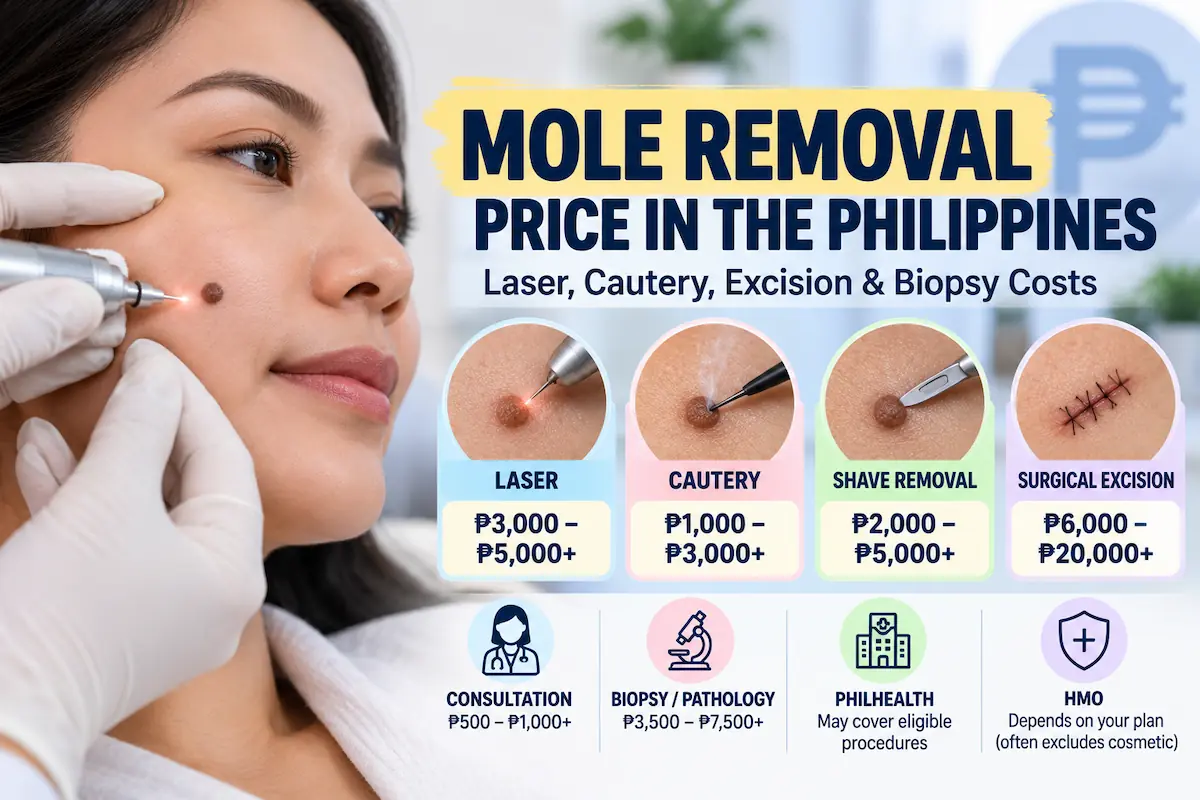
Two different prices hide behind the question, “How much is mole removal in the Philippines?” One is for a small mole being removed mainly for cosmetic reasons. The other is for a mole that a doctor wants to remove and possibly send for biopsy or histopathology. Those are not the same service.
So the most useful answer is:
Simple cosmetic mole removal can start around ₱1,000–₱5,000, but a mole that needs biopsy or surgical removal can cost several thousand pesos more.
The final bill depends much more on what the mole needs medically than on the word “mole”.
MGC’s current price list shows ₱1,000 for flat mole removal and ₱1,500 for raised mole removal, while SHIP Clinic lists mole removal starting at ₱3,000. Adarna currently lists physician-led laser mole removal from ₱5,000 and a separate ₱600 doctor’s consultation.
First, Decide Which Price You Are Actually Comparing
A clinic may quote “Mole removal: ₱1,500.” Another dermatologist may quote “Minor surgery: ₱15,000.” The second clinic is not necessarily ten times more expensive for the same thing. It may be offering a completely different procedure. A useful way to think about current pricing is:
| Situation | Current Published Prices |
|---|---|
| Small cosmetic flat mole | from ₱1,000 |
| Small cosmetic raised mole | from ₱1,500 |
| General clinic mole-removal service | from ₱3,000 |
| Physician-led laser mole removal | from ₱5,000 |
| Minor surgery / biopsy | from ₱3,500 |
| Dermatologist-performed skin biopsy | ₱6,000–₱7,500 |
| Dermatologist-performed minor skin surgery | ₱12,000–₱20,000 |
Skinique, for example, currently prices skin biopsy at ₱6,000–₱7,500 and minor dermatologic surgery for moles, cysts and other lesions at ₱12,000–₱20,000. That gives a much more realistic picture than one nationwide “average mole removal price.”
When a ₱1,000 Mole Removal Can Make Sense
MGC Aesthetics in Tarlac currently publishes a flat mole removal ₱1,000 starting price and a raised mole removal ₱1,500 starting price. These are starting cosmetic prices. A small, stable, clearly benign-looking lesion may receive that kind of quote. But the amount can change if you have:
- a larger mole;
- several moles;
- a deeper lesion;
- a difficult facial location;
- a lesion that needs physician assessment first.
Also ask whether the price is per mole or per session. That difference matters if you want several lesions removed.
A Doctor-Led Clinic May Start Closer to ₱3,000–₱5,000
SHIP Clinic currently publishes that mole removal starts at ₱3,000 as part of its dermatology services. Its site says its dermatology team evaluates and treats both medical and aesthetic skin problems.
Adarna Medical Aesthetics currently lists Laser mole removal from ₱5,000 plus a doctor’s consultation ₱600. Adarna also makes an important pricing point on its own page: Prices marked “from” are confirmed at consultation. That is exactly how a patient should read most online mole-removal prices.
“From ₱5,000” is not the same as “every mole costs ₱5,000.”
Why the Removal Method Changes the Price
There is no single best technique for every mole.
Laser or other destructive treatment
Some Philippine aesthetic clinics offer laser removal for selected lesions. The main pricing advantage is that a small cosmetic lesion may be treated relatively quickly. But laser or another destructive method may destroy tissue rather than preserve a complete sample.
That is important if the lesion needs to be examined under a microscope. So laser is not simply the “modern version” of surgical removal. If a mole is suspicious, diagnosis matters more than cosmetic convenience.
Shave removal
A doctor may remove a raised portion of a selected mole by shaving it at skin level or slightly below. This may avoid stitches in some cases. But whether shave removal is appropriate depends on the mole and the reason it is being removed.
Surgical excision
With excision, the doctor cuts out the lesion and generally closes the wound with stitches when needed. This can be appropriate when a lesion is:
- deeper;
- larger;
- being removed completely;
- medically suspicious;
- being sent for histopathology.
The procedure may therefore include more than the removal itself:
- local anesthetic;
- sterile minor-surgery setup;
- sutures;
- specimen handling;
- pathology;
- wound review.
That is one reason a surgical quote can be far higher than a cosmetic-laser advertisement.
The Mole’s Appearance Can Change the Entire Price Conversation
If the mole is simply unwanted for cosmetic reasons, price comparison makes sense after it has been appropriately assessed.
If it is:
- changing in size;
- changing color;
- changing shape;
- irregular at the edges;
- repeatedly bleeding;
- persistently itching;
- looking very different from your other moles;
The first question should be “Does this need a biopsy?” not “Which clinic has the cheapest laser?”
Skinique specifically separates mole and skin-lesion assessment, biopsy, and minor dermatologic surgery instead of treating every skin growth as an aesthetic service.
How Much Is a Mole Biopsy?
This is where the cost can change sharply. LabXpert currently publishes that Minor Surgery (Biopsy) starts at ₱3,500 and requires an appointment.
Skinique publishes Skin biopsy ₱6,000–₱7,500 and describes it as a dermatologist performed procedure in which a skin sample is obtained for histopathologic examination. It separately lists Minor dermatologic surgery ₱12,000–₱20,000 for procedures involving moles, cysts and other benign or suspicious growths.
These numbers illustrate why a biopsy-based medical removal should not be compared with a ₱1,000 aesthetic-service advertisement.
If a removed mole turns out to need further treatment, the costs can grow beyond the procedure itself. Our guide to the cost of chemotherapy gives an idea of that larger budget.
Histopathology May Be a Separate Charge
After tissue is removed, it may be sent to a pathology laboratory. That can produce another bill. UP Philippine General Hospital currently publishes surgical-pathology charges such as:
Public hospitals can be a lower-cost option for minor surgery. You can check the laparoscopic surgery cost to see how PGH prices its operations.
- Small tissue biopsy under 1 cm — ₱345–₱770
- Medium tissue biopsy 1–2 cm — ₱410–₱850
- Large tissue biopsy over 2 cm — ₱630–₱1,045
depending on the applicable PGH rate category. Those are laboratory pathology charges, not the cost of the actual mole-removal procedure. Private pathology charges can differ.
So if your doctor recommends excision or biopsy, ask: “Is histopathology already included in my quote?”
Why Two Similar Moles Can Receive Different Prices
Size
A larger lesion can require:
- more anesthetic;
- a larger wound;
- more difficult closure;
- longer procedure time.
Location
A mole on the:
- eyelid;
- nose;
- lip;
- face;
can require more careful planning than a similar lesion on another part of the body. PhilHealth’s current procedure schedule itself separates benign lesion excision by anatomical location, including separate codes for the face, ears, eyelids, nose and lips.
Number of moles
Some clinics price per lesion while others may quote per session or treatment area. Do not assume ₱2,000 × 5 moles = ₱10,000 until the clinic explains its pricing.
Flat vs raised
MGC is a good real price; it currently prices flat at ₱1,000 versus raised at ₱1,500.
Biopsy requirement
Once tissue needs to be preserved and sent for pathology, the procedure is no longer comparable to simple cosmetic destruction.
What Happens During the Procedure?
The exact experience depends on the method. For many minor procedures, the treatment area is cleaned and local anesthesia is used. That means the patient is awake, while the treated area is numbed.
The provider then performs the selected technique for example:
- shave removal;
- excision;
- cautery;
- laser or another destructive method.
If an excision is performed, stitches may be required. If the lesion is being investigated, the tissue may be placed in a specimen container and sent to pathology.
The most useful question before the appointment is “Will I need stitches, and will the tissue be sent to the lab?” Those two answers tell you a lot about both the procedure and the expected cost.
Recovery Is Not Simply “2 Days vs 1 Week”
I would not use the exact recovery statement in the second article. Current Philippine clinic information shows that downtime varies considerably.
Skinique currently describes:
- biopsy as usually having little immediate downtime;
- treatment of skin growths as potentially involving 1–7 days;
- minor dermatologic surgery as roughly 1–3 days of downtime in its booking information.
But “downtime” is not the same as full wound healing. You may be able to work normally while the skin is still:
- crusting;
- closing;
- changing color;
- forming a scar.
Follow the clinic’s specific instructions rather than planning around one universal recovery number.
Will Mole Removal Leave a Scar?
Potentially, yes. “Scarless mole removal” should be treated cautiously. The final mark depends on:
- method;
- mole depth;
- size;
- body location;
- wound closure;
- skin type;
- tendency toward keloids;
- aftercare.
A surgical excision may leave a line-shaped scar. A shave or destructive technique may leave:
- a round mark;
- lighter skin;
- darker pigmentation;
- a shallow depression.
So before choosing between laser and surgery, ask “What type of scar is most likely with this method?”
A slightly higher-priced procedure may make more sense if it is medically or cosmetically better suited to the lesion.
Can a Mole Come Back?
Yes, especially if the procedure does not remove all mole cells. A mole that reappears after removal should be reassessed rather than automatically treated again. Do not assume recurrence simply means “I need another laser session.”
Tell the doctor that the lesion was previously removed and, if possible, bring:
- old photos;
- previous pathology report;
- clinic records.
Can I Remove Several Moles at Once?
Possibly. But first, confirm that they are actually moles. Patients commonly use “mole” to describe several different lesions, including:
- skin tags;
- warts;
- seborrheic keratoses;
- milia;
- other benign growths.
SHIP, for price lists, mole removal separately from cautery treatment for warts and other dermatologic procedures. The treatment and therefore price can change once the lesion is correctly identified.
Does an HMO Cover Mole Removal?
The answer depends heavily on why it is being removed. Purely aesthetic treatment is commonly excluded.
MediCard’s current VIP plan terms, for example, exclude cosmetic surgery and aesthetic dermatologic care such as electrocautery and chemical treatment for certain benign skin lesions.
A medically necessary:
- dermatologist evaluation;
- biopsy;
- suspicious-lesion excision;
may be treated differently under a particular plan. Before paying, ask “If my dermatologist considers this medically necessary rather than cosmetic, does my plan cover the consultation, biopsy or excision?”
If you are still comparing HMO options, see our Best HMO in the Philippines guide.
Can PhilHealth Cover Mole Removal or Biopsy?
Potentially—but this is another area where cosmetic removal and medical removal must be separated. PhilHealth’s current 2024 procedure case-rate list includes Skin biopsy (RVS 11100) — ₱7,098 case rate and codes for shaving and excision of benign skin lesions.
For example, benign lesion excision on the trunk, arms, or legs (RVS 11400) ₱7,098 case rate, while specified benign facial lesion excisions have a ₱8,010.60 case rate.
The current list also includes a ₱11,700 case rate for certain destruction procedures involving benign facial or premalignant lesions, including laser under the relevant code.
These are PhilHealth case rates, not promises that PhilHealth will pay for any cosmetic mole you want removed.
Actual coverage depends on things such as:
- medical indication;
- diagnosis;
- procedure code;
- accredited provider;
- eligibility;
- how the facility files the claim.
So ask the hospital or clinic, “If this is medically necessary, can this exact procedure be filed with PhilHealth, and what will I still pay?” For purely cosmetic mole removal at an aesthetic clinic, do not assume PhilHealth applies.
A Better Way to Compare Quotes
The strongest practical advice from your second article was to stop comparing only the headline number. Ask each clinic for this:
| Ask | Clinic’s Answer |
|---|---|
| Consultation | ₱_____ |
| Is pricing per mole or per session? | _____ |
| Removal method | _____ |
| Local anesthesia included? | Yes / No |
| Will tissue be preserved? | Yes / No |
| Histopathology needed? | Yes / No |
| Histopathology included? | Yes / No |
| Stitches required? | Yes / No |
| Dressing/medicines included? | Yes / No |
| Follow-up included? | Yes / No |
| Suture removal included? | Yes / No |
| HMO accepted? | Yes / No |
| Can it be filed with PhilHealth if medically indicated? | Yes / No |
That makes a ₱3,000 clinic quote and a ₱7,000 dermatologist quote much easier to compare fairly.
Do Not Try to Remove a Mole at Home
Avoid:
- cutting it;
- burning it;
- tying it off;
- applying strong acids;
- unregulated “mole remover” pens;
- unknown creams bought online.
Apart from infection and scarring, the bigger problem is diagnostic delay. If the lesion is unusual, destroying it at home can remove the opportunity to have it properly assessed. A cheap home method can become very expensive if you later need treatment for:
- infection;
- scarring;
- recurrence;
- delayed diagnosis.
So What Should You Actually Budget?
Based on current directly published Philippine prices:
Small cosmetic mole
Plan for roughly ₱1,000–₱3,000+. MGC starts at ₱1,000–₱1,500, while SHIP starts at ₱3,000.
Physician-led laser removal
Plan around ₱5,000+. Adarna currently starts laser mole removal at ₱5,000, with a ₱600 consultation listed separately.
Biopsy
Current price range from ₱3,500 starting price at LabXpert to ₱6,000–₱7,500 at Skinique.
Dermatologic surgery
Skinique currently lists ₱12,000–₱20,000 for minor dermatologic surgery involving moles and other skin lesions. That is why the final answer should never simply be “Mole removal costs ₱2,500.”
A better answer is:
A small cosmetic mole may cost around ₱1,000–₱5,000 to remove, while biopsy or surgical removal can cost roughly ₱3,500–₱20,000+ depending on the procedure, provider and pathology requirements.
The Number Worth Asking For
If the mole is stable and has been assessed as benign, compare cosmetic quotes and ask whether pricing is per mole or per session.
If it is changing, bleeding, irregular or otherwise concerning, do not start by shopping for the cheapest laser. Ask “Does this need biopsy or surgical removal, and what is the total price including pathology?”
That one question can tell you far more than a ₱1,000 promotional headline.
Medical note: This article is for price comparison only. It cannot determine whether a mole is benign. A new, changing, bleeding or otherwise unusual mole should be medically assessed before cosmetic removal.
How CareCost PH Checked These Prices
CareCost PH reviewed current first-party Philippine price lists rather than relying mainly on clinic directories. Current sources included:
- MGC Aesthetics;
- SHIP Clinic;
- Adarna Medical Aesthetics;
- LabXpert Medical & Diagnostic Center;
- Skinique Dermatology and Laser Center;
- UP–Philippine General Hospital;
- PhilHealth’s current procedure case-rate schedule.
We deliberately did not use a directory-derived “national average” as the main price, because directory starting prices can mix:
- different clinic types;
- different procedures;
- cosmetic and medical removal;
- outdated listings.
We also separated cosmetic removal from biopsy and minor dermatologic surgery from histopathology because these are not interchangeable services. See How We Research Prices for our methodology.
Prices checked: October 5, 2026.






2 Comments