
Tooth Filling Price Philippines: How Much Is “Pasta” Per Tooth or Surface?
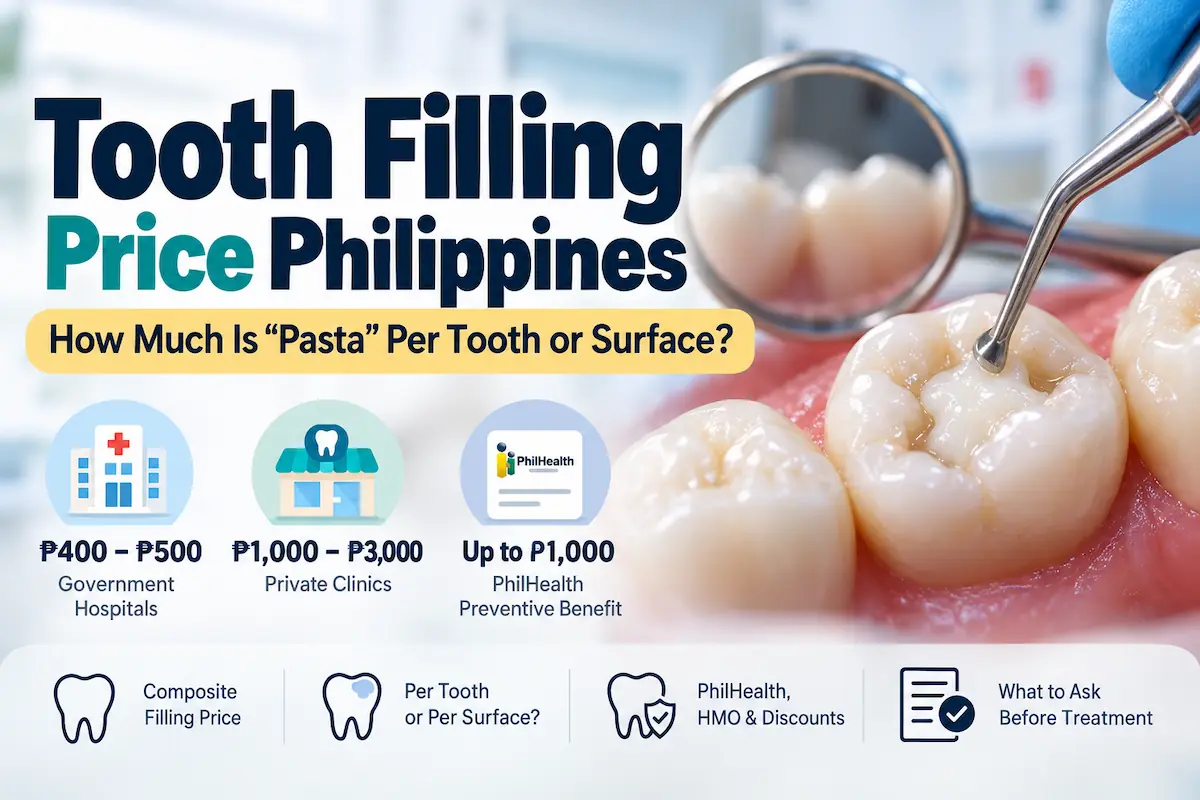
A basic permanent tooth filling or “pasta” can cost around ₱400–₱500 at several government hospitals, while current private-clinic listings reviewed by CareCost PH commonly show approximately ₱1,000–₱3,000 for a simple restoration or per tooth surface.
But the most important thing to understand before comparing prices is this:
Some dentists charge per tooth. Others charge per surface.
One tooth can have decay on more than one surface. So if a clinic charges ₱1,500 per surface, restoring one tooth involving three surfaces could cost ₱4,500, not ₱1,500. That difference explains why two people can both say they had “one tooth filled” but receive very different bills.
What Tooth Fillings Actually Cost at Philippines
Rather than using one supposed nationwide average, here are published rates from actual Philippine providers.
| Provider | Pricing Basis | Published Price |
|---|---|---|
| Zamboanga Regional Medical Center | Permanent filling | ₱400 |
| Ilocos Sur Medical Center | Composite filling | ₱500 per surface |
| Dr. Jose Fabella Memorial Hospital | Permanent filling, 1 surface | ₱500 |
| Southern Isabela Medical Center | Permanent filling | ₱500 per tooth |
| Enhance Dental Clinic, Daraga | Tooth restoration / pasta | ₱1,000–₱2,500 |
| Tooth&Go, Parañaque | Composite filling | ₱1,763 |
| Easethetic Dental Lounge, Quezon City | Posterior restoration | ₱1,000–₱2,000 per surface |
| Easethetic Dental Lounge, Quezon City | Anterior restoration | ₱1,500–₱3,000 per surface |
Ilocos Sur Medical Center currently lists composite filling at ₱500 per surface, while Southern Isabela Medical Center’s 2026 Citizen’s Charter lists permanent filling at ₱500 per tooth. Zamboanga Regional Medical Center publishes a ₱400 permanent-filling fee.
Current private examples show a wider range. Enhance Dental Clinic advertises restoration at ₱1,000–₱2,500, Tooth&Go lists composite filling at ₱1,763, and Easethetic lists posterior restoration at ₱1,000–₱2,000 per surface and anterior restoration at ₱1,500–₱3,000 per surface.
These are published provider examples, not a regulated Philippine average.
Dental treatment often comes in stages, and wisdom tooth removal may be one of them. See the cost of wisdom tooth extraction for its price breakdown.
Before Comparing Prices, Understand “Per Surface”
This is the part many price guides do not explain clearly enough. A tooth does not have only one billable area. Depending on the tooth, dentists describe surfaces such as:
- chewing surface;
- front or back side;
- cheek-facing side;
- tongue-facing side;
- contact surfaces between teeth.
A cavity might involve only one surface or spread across two or more.
Example
If your dentist charges ₱1,500 per surface:
| Surfaces Restored | Example Cost |
|---|---|
| 1 surface | ₱1,500 |
| 2 surfaces | ₱3,000 |
| 3 surfaces | ₱4,500 |
It is still one tooth, but three surfaces are being restored.
This pricing method is clearly used in the Philippines. Ilocos Sur Medical Center charges composite filling per surface, and Easethetic’s current private-clinic price list also specifies per-surface pricing.
Ask this before treatment
Instead of only asking: “Magkano po ang pasta?” ask:
“Per tooth po ba o per surface ang charge, at ilang surfaces ang kailangan gawin?”
That question can prevent one of the most common billing surprises.
Front Tooth and Back Tooth Fillings Can Cost Different Amounts
The location of the tooth can affect the price. For example, Easethetic Dental Lounge currently publishes:
Posterior/back tooth: ₱1,000–₱2,000 per surface
Anterior/front tooth: ₱1,500–₱3,000 per surface
It also lists a possible ₱500 liner/base when required. This does not mean all Philippine dentists charge more for front teeth. It simply shows why you should compare the actual treatment quotation, not assume that one advertised filling price applies to every tooth.
Front-tooth work may require extra attention to appearance, contour and shade matching. Back teeth have different chewing and functional demands.
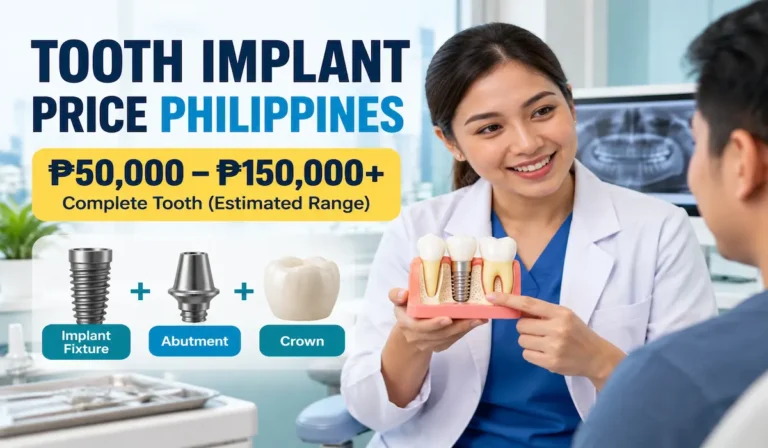
If your dentist also recommends a tooth implant, you can check the cost of a dental implant before your next appointment.
Composite Filling Price in the Philippines
Composite resin is the tooth-colored material commonly meant when patients ask about permanent “pasta” or light-cure filling. Published Philippine examples include:
| Provider | Composite / Light-Cure Price |
|---|---|
| Ilocos Sur Medical Center | ₱500 per surface |
| San Lazaro Hospital | ₱480 for 1 surface — 2024 rate |
| Tooth&Go | ₱1,763 |
| Easethetic — posterior | ₱1,000–₱2,000 per surface |
| Easethetic — anterior | ₱1,500–₱3,000 per surface |
San Lazaro Hospital’s official page still lists ₱480 for a one-surface light-cure permanent filling, but that rate has an effective date of March 1, 2024, so it should not be treated as a guaranteed 2026 quotation.
For private treatment, a practical planning figure from the current clinic listings reviewed is therefore approximately ₱1,000–₱3,000 for a simple restoration or per surface depending on the dentist’s billing method and the tooth involved.
Government Hospital Tooth Filling Prices
Government dental services can be considerably cheaper, but there is no single nationwide government price.
Zamboanga Regional Medical Center
- Permanent filling — ₱400
- Temporary filling — ₱300
Its published price page also notes that prices can change based on material costs and procurement.
Ilocos Sur Medical Center
- Composite filling — ₱500 per surface
Dr. Jose Fabella Memorial Hospital
- Permanent filling, 1 surface — ₱500
- Temporary filling — ₱350
- Periapical X-ray — ₱400
Southern Isabela Medical Center
Its 2026 Citizen’s Charter lists:
- Permanent filling — ₱500 per tooth
- Temporary ART filling — ₱500 per tooth
- Direct pulp capping — ₱500
These examples also demonstrate why “per tooth” and “per surface” should never be treated as the same pricing unit.
Government Does Not Always Mean ₱400–₱500
Government rates can also be higher. For example, Bicol Medical Center’s published March 2024 schedule lists:
- Composite Class I — ₱1,300
- Composite Class II — ₱1,550
- Composite Class III — ₱1,300
- Composite Class IV — ₱1,550
- Composite Class V — ₱1,300
- Modified composite filling — ₱1,550
- Temporary filling — ₱1,100
Those figures are older, so CareCost PH does not use them to define the main 2026 range. They are useful for showing that:
“Government hospital” does not automatically mean a ₱500 filling.
Check the specific facility you plan to visit.
Can You Get a Filling for Free at a Government Facility?
Sometimes — but this is local-program dependent, not a nationwide rule. A useful current example comes from Romblon. In February 2026, the Romblon Provincial Health Office reported that government dental clinics at:
- Romblon Provincial Hospital;
- Romblon District Hospital;
- Tablas Island District Hospital;
offer services including fillings free of charge, supported by the provincial government and subject to available equipment. Free dental services are also available at certain rural health centers in the province.
This does not mean all Philippine government hospitals provide free fillings. If you are looking for the cheapest option, ask your:
- provincial hospital;
- city or municipal health office;
- rural health unit;
- local government dental clinic;
whether restorative treatment is available and what eligibility rules apply.
Glass Ionomer Filling Price
Glass ionomer cement (GIC) is another tooth-colored restorative material. It can be used in selected situations depending on the tooth, location of the cavity and treatment plan. Published examples show how different public and private pricing can be.
San Lazaro Hospital
Its March 2024 schedule lists:
- Glass ionomer permanent filling, 1 surface — ₱200
- Additional surface — ₱50
Tooth&Go
Its current booking page lists:
- Glass ionomer filling — ₱1,763
These should not be presented as an official national ₱200–₱1,763 range. They are two examples from very different healthcare settings.
Temporary Filling Price
A temporary filling is not the same service as a permanent composite restoration. Published government examples include:
- San Lazaro Hospital — ₱150
- Zamboanga Regional Medical Center — ₱300
- Fabella — ₱350
- Southern Isabela Medical Center — ₱500 for temporary ART
If you are quoted a surprisingly low amount, ask
“Temporary po ba ito o permanent filling?”
A temporary restoration may be appropriate for a particular treatment stage, but it should not be compared directly with a permanent composite filling.
Why Current Price Lists Focus on Composite and Glass Ionomer Instead of Amalgam
You may still find older Philippine articles listing silver or amalgam filling prices. Current pricing pages are much more likely to feature composite and glass ionomer. One reason is Philippine regulation.
FDA Circular No. 2022-003 banned mercury-added dental amalgam capsules and liquid mercury for use in dental restorative purposes.
For that reason, CareCost PH does not publish a current “amalgam filling price” alongside composite and GIC as though they were equally available modern options.
If you already have an old silver filling, that does not mean it should automatically be removed. Whether an existing restoration requires treatment is a clinical question for your dentist.
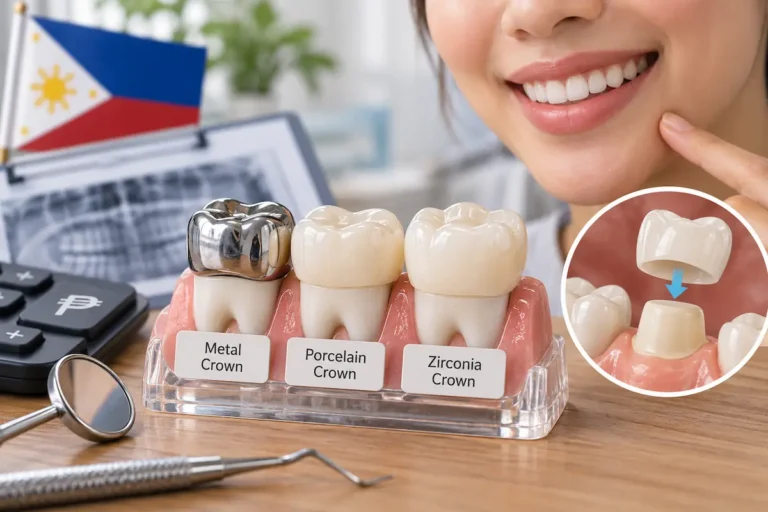
Ceramic Inlays, Onlays and Crowns Are Not Ordinary “Pasta”
Some competing price guides place composite filling, ceramic filling, porcelain restoration and crowns in the same price table. That can be misleading.
A direct composite filling is normally completed directly in the tooth. An inlay, onlay or crown is a different type of restoration and can involve:
- different materials;
- laboratory or digital fabrication;
- more extensive tooth preparation;
- substantially different pricing.
If your dentist recommends one of these, ask for a separate quotation instead of comparing it with a ₱1,000–₱2,000 basic “pasta.”
Your Filling May Not Be Your Entire Bill
A filling advertised at ₱1,500 does not necessarily mean the entire visit will cost ₱1,500. Depending on the tooth and clinic, there may be separate charges.
| Possible Separate Cost | Published Example |
|---|---|
| Dental consultation | ₱300 at Enhance Dental Clinic |
| Periapical X-ray | ₱500 at Enhance Dental Clinic |
| Periapical X-ray | ₱400 at Fabella |
| Additional liner/base | ₱500 at Easethetic |
| Direct pulp capping | ₱500 at Southern Isabela Medical Center |
Enhance currently lists a ₱300 consultation, ₱500 digital periapical X-ray, and tooth restoration starting at ₱1,000–₱2,500.
Easethetic separately lists an additional ₱500 liner/base for tooth restoration. These amounts are examples, not mandatory nationwide fees. A different clinic may include some of these items in its treatment price.
Ask for the total
Before treatment begins, ask:
“Including consultation, X-ray, anesthesia, liner and the filling itself, what is the expected total?”
That is much more useful than comparing only advertised starting prices.
Do You Need an X-Ray Before Getting a Filling?
Not every simple filling automatically requires an X-ray. A dentist may recommend one if the location or depth of the cavity cannot be assessed adequately by examination alone.
Published examples include:
- Fabella periapical X-ray — ₱400
- San Lazaro dental X-ray — ₱500
- Enhance digital periapical X-ray — ₱500
If your dentist orders an X-ray, ask whether it is included in your quotation. CareCost PH also has a separate guide covering X-ray prices in the Philippines, including dental imaging.
What If the Cavity Is Too Deep for a Normal Filling?
A visible cavity does not tell you how much tooth structure has been affected. After examining the tooth, a dentist may find that a simple direct restoration is not appropriate.
That could change both the treatment and the cost. For example, a tooth may require additional management when decay is very deep or the tooth is extensively damaged.
This is why a clinic can advertise “Pasta starts at ₱1,000” but give you a different quotation after the examination. Do not choose between a filling, root canal or extraction based only on price.
When decay reaches the nerve, a filling is no longer enough and root canal treatment may be needed. You can compare the root canal treatment cost before deciding.
If a more extensive treatment is recommended, ask the dentist to explain:
- what was found;
- why a simple filling is not suitable;
- what alternatives exist;
- what each treatment would cost.
Does PhilHealth Cover Tooth Fillings?
PhilHealth’s preventive oral-health benefit does include a type of dental restoration, but it does not mean every routine filling is covered.
Under PhilHealth’s preventive oral-health benefit, eligible beneficiaries can receive:
- mouth examination/oral screening;
- dental prophylaxis or cleaning;
- fluoride varnish application;
- pit-and-fissure sealant or root-surface protection/Class V restoration, when applicable;
- emergency tooth extraction.
PhilHealth sets a maximum benefit of ₱1,000 per beneficiary per year.
How the ₱1,000 benefit is structured
PhilHealth’s fee schedule provides:
| Covered Service | PhilHealth Payment |
|---|---|
| First preventive visit | ₱300 |
| Second preventive visit | ₱300 |
| Sealant or Class V/root-surface restoration | ₱200 per eligible tooth |
| Maximum number of teeth for this component | 2 teeth per year |
The second preventive visit must be at least four months after the first. The potential total is therefore:
₱300 + ₱300 + ₱200 + ₱200 = ₱1,000 maximum per year.
This does not mean PhilHealth pays ₱200 for every cavity
The official benefit specifically refers to pit-and-fissure sealant or root-surface protection/Class V restoration with a maximum of two teeth. So do not assume that an ordinary chewing-surface or multi-surface composite filling automatically qualifies.
Ask the accredited provider whether the exact restoration you need falls under the benefit.
Public vs private PhilHealth providers
PhilHealth states that there is no co-payment in participating public facilities for services covered by this package.
For participating private facilities, the official maximum co-payment table allows:
- up to ₱1,500 per visit for the mandatory preventive-care component;
- up to ₱600 per tooth for an eligible sealant or Class V/root-surface restoration.
Providers may charge less than these maximums. Before relying on PhilHealth, ask:
“Is the filling I need covered under the Preventive Oral Health Benefit, and is this provider accredited for it?”
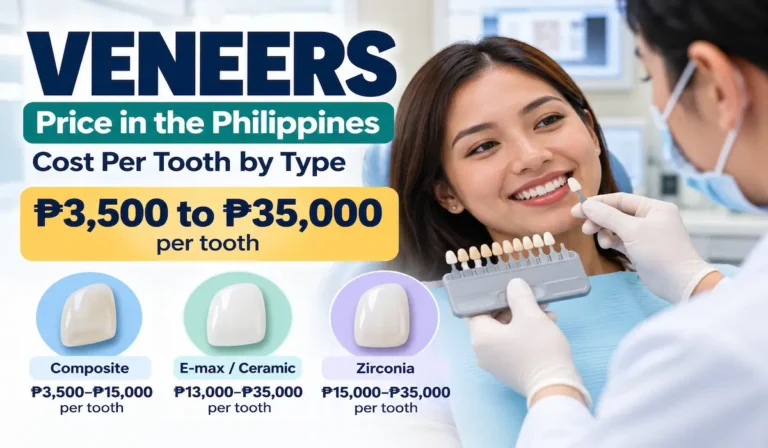
If you are also planning dental veneers, it helps to compare the full treatment cost early. You can check the cost of veneers.
What If You Have an HMO?
HMO dental benefits differ substantially by plan. A plan may cover:
- permanent fillings;
- temporary fillings;
- composite/light-cure restoration;
- only a limited number of surfaces;
- only accredited dental clinics;
- services up to an annual dental limit.
Another plan from the same company may have different benefits.
Before treatment, ask:
- Is permanent filling covered?
- Is composite/light-cure filling included?
- Is coverage calculated per tooth or per surface?
- How many surfaces or teeth are allowed?
- Do I need an LOA or prior approval?
- Is this dentist accredited?
- Is there a co-payment or annual limit?
Do not assume that “dental coverage included” means every filling will be fully paid.
Senior Citizen Discount for Tooth Filling
Under the Expanded Senior Citizens Act, qualified senior citizens receive a 20% discount and VAT exemption, where applicable, on medical and dental services in private healthcare facilities.
The implementing rules specifically describe dental services as including permanent and temporary fillings, among other treatments.
The law also provides qualified senior citizens with free medical and dental services in government facilities, subject to applicable rules and requirements. Bring valid proof of eligibility and ask the facility to apply the benefit before payment.
PWD Discount for Dental Filling
Qualified PWDs are entitled to at least a 20% discount on eligible medical and dental services, subject to applicable rules.
The implementing regulations include medical and dental services in both government and private healthcare facilities among the covered categories.
Because the final dental bill may contain several components, ask the clinic how the discount applies to:
- the restoration;
- consultation;
- professional fees;
- X-ray or other diagnostic charges.
Looking for a Cheaper Filling? Start Here
If budget is your main concern, compare options in this order.
1. Local government dental services
Check your:
- provincial hospital;
- city health office;
- municipal health office;
- rural health unit.
Some LGUs subsidize restorative dental care. Romblon’s 2026 program is a current example where fillings are provided free in participating government facilities, subject to equipment availability.
2. Government hospitals with published rates
Several government examples reviewed by CareCost PH list permanent fillings at around ₱400–₱500, although other facilities charge more.
3. PhilHealth oral-health providers
If your required restoration qualifies for the preventive oral-health benefit, check whether there is an accredited provider you can use.
4. Your HMO
Check your dental benefit before paying cash. Some plans cover filling services or a limited number of surfaces.
5. Dental schools or supervised teaching clinics
Teaching institutions may sometimes offer reduced-cost treatment, but current fees and patient-acceptance rules are not consistently published online.
Confirm before travelling.
Before the Dentist Starts, Ask These 8 Questions
This is the most useful checklist to take from this article:
- Is the price per tooth or per surface?
- How many surfaces need to be restored?
- What material will you use?
- Is it a permanent or temporary filling?
- Is the consultation included?
- Do I need an X-ray, liner or another additional procedure?
- Does PhilHealth, my HMO, senior or PWD benefit apply?
- What is the expected total before treatment begins?
If several teeth need fillings, also ask for a written treatment plan showing the cost for each tooth.
Frequently Asked Questions
Magkano ang pasta sa ngipin sa Pilipinas?
Several government facilities reviewed by CareCost PH currently or recently publish basic permanent filling prices around ₱400–₱500.
Current private-clinic listings reviewed show approximately ₱1,000–₱3,000 for many common restorations or per surface. The final price depends heavily on whether the clinic charges per tooth or per surface.
Is ₱1,500 for a Tooth Filling Normal?
Yes, ₱1,500 falls within several current private-clinic price examples. But ask whether ₱1,500 means:
- one tooth;
- one surface;
- or a starting price.
A multi-surface filling could cost more.
Is a Filling Charged Per Tooth or Per Surface?
Both systems exist. Southern Isabela Medical Center’s 2026 schedule prices permanent filling per tooth, while Ilocos Sur Medical Center prices composite filling per surface.
Private clinics may also charge per surface.
How Much Is Composite Filling in the Philippines?
Current examples include:
- ₱500 per surface at Ilocos Sur Medical Center;
- ₱1,763 at Tooth&Go;
- ₱1,000–₱2,000 per posterior surface at Easethetic;
- ₱1,500–₱3,000 per anterior surface at Easethetic.
How Much Is a Temporary Filling?
Published government examples reviewed range from approximately ₱150 to ₱500, depending on the facility and type of temporary restoration.
A temporary filling should not be compared directly with a permanent composite restoration.
Why Can Filling One Tooth Cost ₱3,000 or More?
One tooth may require restoration of several surfaces. The clinic may also charge separately for:
- examination;
- X-ray;
- liner/base;
- other treatment required because of the depth of the cavity.
Ask for an itemized quotation.
Does PhilHealth Cover Pasta?
Only certain restorative services under the preventive oral-health package are specifically covered.
PhilHealth includes root-surface protection/Class V restoration or pit-and-fissure sealant, up to two eligible teeth per year, as part of a maximum ₱1,000 annual preventive oral-health benefit.
Do not assume every routine cavity filling is included.
Can You Get Free Pasta at a Public Hospital?
Some local government programs do provide fillings free of charge.
Romblon’s Provincial Health Office reported in February 2026 that participating government hospitals provide fillings and other dental services free through provincial support, subject to available equipment.
Availability varies by province and facility.
How CareCost PH Checked These Prices
CareCost PH reviewed publicly available information from:
- DOH and government hospitals;
- current private dental-clinic price and booking pages;
- PhilHealth benefit documentation;
- Philippine laws and implementing regulations;
- government reports on local dental programs.
Priority was given to actual provider-published prices rather than generalized directory estimates. We also kept per-tooth pricing separate from per-surface pricing because combining the two can produce a misleading price range.
Older government rates were used only when they added useful context and are clearly identified by date. CareCost PH did not call clinics, interview dentists or visit these facilities for this article. Prices checked: September 24, 2026.
For more information about our methodology, see the CareCost PH How We Research Prices page.
What Should You Budget?
For a simple filling, a useful starting point from the provider prices reviewed is: Government/public facility: around ₱400–₱500 at several facilities, although some charge more and some local programs may provide the service free.
Private clinic: around ₱1,000–₱3,000 for many current examples, often depending on whether the price is per tooth or per surface.
The most important question is not simply:
“Magkano ang pasta?”
It is:
“How many surfaces need to be restored, what does the quoted price include, and what will my total bill be?”
A clinic charging ₱1,500 per surface could cost more for one three-surface tooth than another dentist quoting one bundled per-tooth price.
Compare the total treatment plan, not only the advertised starting price.
Medical note: Prices are for general information and can change. A licensed dentist needs to examine the tooth to determine whether a filling is appropriate and which restoration or other treatment is suitable.

5 Comments